Scissor Lift Maintenance Tips to Extend Equipment Life
Picture this: it’s 7am on a busy construction site, your team is ready to start the day, and the scissor lift won’t raise. The platform is dead. Work stops, trades stand around, the project manager is on the phone, and the repair call-out costs more than a month’s worth of preventive servicing. It’s a situation that plays out on Australian job sites more often than it should, and in almost every case, it was preventable.
Scissor lift maintenance involves a series of routine inspections, lubrication, fluid checks, and structural assessments designed to keep equipment safe, operational, and compliant with Australian workplace health and safety obligations. A consistent maintenance routine is the single most effective way to extend equipment life, prevent unplanned downtime, and meet your legal duties as an equipment owner or operator.
This guide covers everything you need to know, from daily pre-start checks through to annual servicing requirements, structured so experienced operators can jump to the section they need and newer users can follow the full process from start to finish.
Why Scissor Lift Maintenance Is Important
Scissor lift maintenance is important because poorly maintained elevated work platforms are a genuine safety risk, a compliance liability, and an unnecessary cost burden for any business that relies on them.
Safety
In Australia, scissor lifts are classified as plant under the Work Health and Safety Act 2011 and its state and territory equivalents. This classification means that maintenance is not optional, it is a legal obligation. According to Safe Work Australia, falls from height remain one of the leading causes of workplace fatalities in this country, and equipment failure is a contributing factor in many of those incidents. A scissor lift with faulty safety systems, degraded tyres, or compromised structural integrity puts operators and everyone around the machine at risk.
Compliance
The relevant Australian Standard is AS 2550.10, which covers the safe use of mobile elevating work platforms (MEWPs). This standard sets out inspection, maintenance, and operational requirements that operators and owners must follow. Most Australian states also require plant registration for scissor lifts above certain platform heights, check with your relevant state regulator (SafeWork NSW, WorkSafe Victoria, SafeWork Queensland, SafeWork SA, or equivalent) for jurisdiction-specific obligations.
Cost and Equipment Longevity
Preventive maintenance typically costs three to five times less than reactive repair. A scheduled hydraulic fluid change costs a fraction of a hydraulic pump replacement caused by running contaminated fluid. Beyond repair costs, well-maintained scissor lifts can operate for 10,000 hours or more over their working lives. A documented maintenance history also directly increases resale value, essential for hire operators and businesses managing equipment fleets.
How Often Should a Scissor Lift Be Serviced?
A scissor lift should be serviced at multiple intervals: daily pre-start checks before every shift, weekly lubrication and fluid inspections, monthly structural and safety device assessments, and a full professional service every 250–500 hours or annually, whichever comes first. Always refer to the manufacturer’s Operation and Maintenance Manual (OMM) as the primary reference for your specific model.
The table below provides a general maintenance schedule. High-use equipment, such as hire fleet units working multiple shifts, will typically require more frequent attention across all intervals.
| Interval | Maintenance Tasks |
|---|---|
| Daily (Pre-Start) | Visual walk-around, fluid levels, battery charge or fuel, tyre and wheel check, controls test, safety device check, logbook entry |
| Weekly | Lubrication of scissor arms and pivot points, hydraulic fluid top-up check, charging system check, cleaning of key components |
| Monthly | Full fluid inspection, scissor arm and chassis structural check, safety device function test, filter condition check |
| 3–6 Monthly | Hydraulic filter replacement, air and fuel filter replacement (diesel models), brake inspection, drive system check |
| Annually | Full OEM-compliant professional service, safety certification (if required by state regulator), load testing, battery capacity test (electric models) |
Some states require periodic inspection certification for elevated work platforms, this is separate to routine servicing and should be factored into your maintenance planning calendar.
Daily Scissor Lift Pre-Start Checks
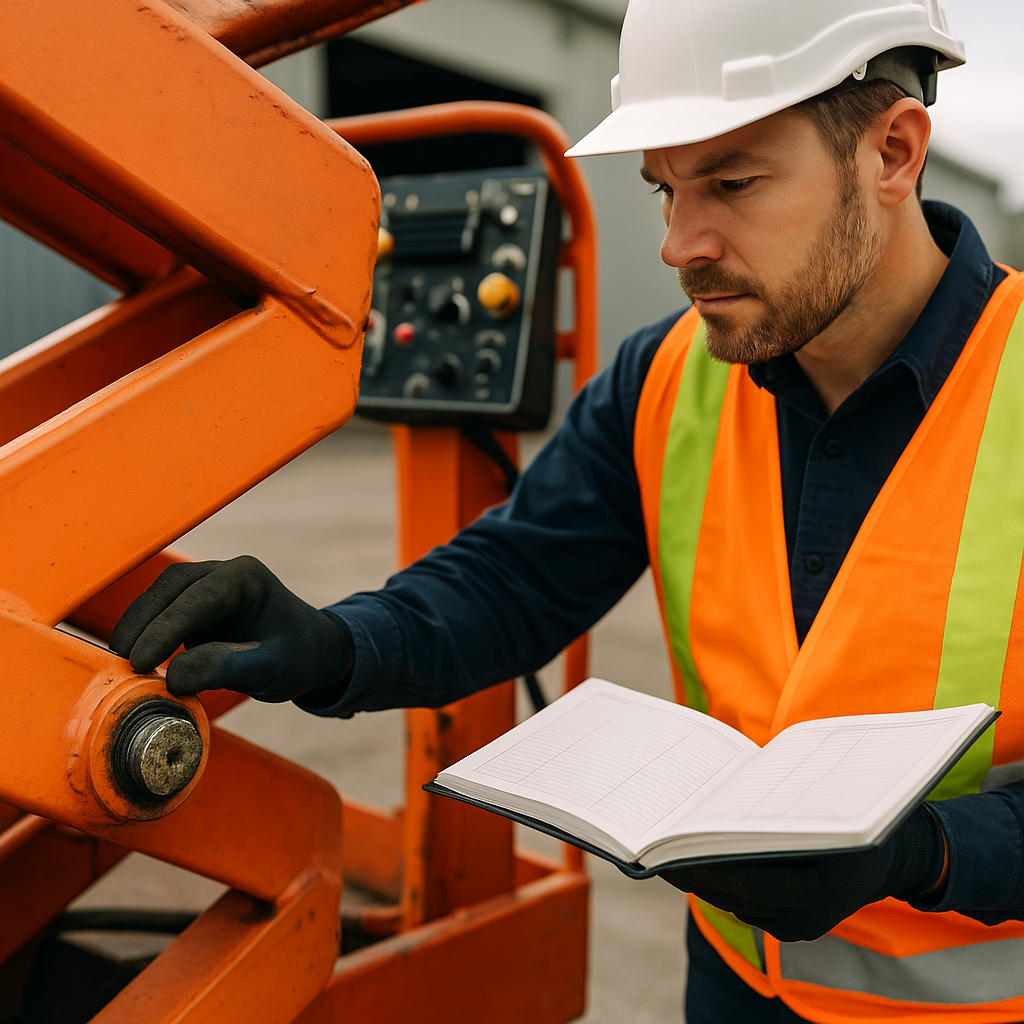
Daily pre-start checks are a legal requirement under Australian WHS regulations and must be completed before every shift, not just at the start of the working day. A thorough pre-start inspection takes approximately 10–15 minutes and is the single most effective way to catch developing problems before they become breakdowns or safety incidents.
How to Conduct a Scissor Lift Pre-Start Inspection
Review the operator manual and last service record
Check for any outstanding faults, recent repairs, or service items due. If a previous operator has flagged an issue in the logbook, address it before proceeding.
Conduct a visual walk-around inspection
Examine the entire machine for visible damage, fluid leaks, loose fittings, cracked welds, or deformation to the chassis, scissor arms, or platform. Look underneath the machine for pooled fluid.
Check all fluid levels
For electric models, confirm battery charge level. For diesel or petrol models, check engine oil, coolant, and fuel. All models should have hydraulic fluid checked, look for correct level, colour, and smell (milky fluid indicates water contamination).
Inspect tyres and wheels
Foam-filled and solid tyres should be checked for cuts, chunking, or delamination. Pneumatic tyres require pressure checks to manufacturer-specified levels. Check that all wheel nuts are present and correctly secured.
Test all controls from the ground panel
Operate the platform raise and lower function, drive functions, emergency stop, and horn. Confirm ground controls override platform controls correctly.
Test all controls from the platform panel
Raise the platform to a low height and test all functions again from the platform control box.
Inspect safety devices
Check that guardrails are secure and undamaged, gate latches function correctly, fall arrest anchor points (if fitted) are intact, and the tilt sensor activates at the appropriate angle.
Assess the work area
Before moving the machine, check ground conditions for soft spots, drains, slopes, or overhead obstructions. Confirm the ground can support the machine’s ground bearing pressure.
Complete and sign the logbook
Record all inspection findings, including items checked and confirmed as serviceable, as well as any defects identified. If a fault is found, tag the machine out of service until it is rectified by a competent person.
Pre-start checks are a legal requirement, and the logbook entry is a legal document. Completing these checks takes approximately 10–15 minutes and is the single most effective way to prevent unexpected breakdowns and workplace incidents.
Essential Scissor Lift Maintenance Tips to Extend Equipment Life
Keeping a scissor lift in good condition requires attention across several key systems. The following maintenance tips address the areas most likely to affect equipment reliability, safety, and longevity.
Keep the Hydraulic System Healthy
The hydraulic system is the heart of any scissor lift. Check fluid levels daily and inspect hoses, cylinders, and fittings for leaks, cracking, or signs of wear. Change hydraulic fluid at manufacturer-specified intervals, typically every 12 months or every 500–1,000 operating hours, whichever comes first. Always use the correct grade of hydraulic fluid specified in the OMM; using the wrong fluid can damage seals and reduce system performance. Look for warning signs such as milky or discoloured fluid (water contamination), slow platform movement, or jerky operation, these indicate the fluid or system needs immediate attention.
Maintain the Battery or Fuel System
For electric scissor lifts: Charge the battery fully after every use. Avoid deep-discharging the battery, as this significantly shortens battery life. For wet-cell (flooded lead-acid) batteries, check electrolyte levels regularly and top up with distilled water as required. Keep terminals clean and free of corrosion. In Australia’s warmer climates, particularly during summer, battery performance can degrade faster than expected. Test battery capacity at least annually, or more frequently in high-use applications.
For diesel and petrol models: Check fuel lines, air filters, and fuel filters at scheduled intervals. Change engine oil and oil filters as per the manufacturer’s schedule. Inspect the exhaust system and cooling system regularly, particularly on machines operating in dusty regional or mining environments where filters block faster.
Lubricate All Moving Parts Regularly
Scissor arms, pivot pins, and cylinder attachment points all require regular greasing. Use the lubricant type and quantity specified in the manufacturer’s manual, over-greasing attracts dirt and grit, which can cause accelerated wear on pivot points. Create a lubrication map or schedule based on your machine’s grease point diagram (usually included in the OMM) to ensure no points are missed. Weekly lubrication checks are generally sufficient for moderate-use machines; high-use equipment may require more frequent attention.
Inspect and Maintain Tyres and Wheels
Tyre condition directly affects machine stability and operator safety. Foam-filled and solid tyres don’t require inflation checks but should be inspected for cuts, chunking, or separation from the rim, any of these defects can compromise stability under load. Pneumatic tyres should be maintained at the manufacturer’s specified pressure; both under- and over-inflation affect load capacity and ground clearance. Check wheel nuts are torqued to the correct specification at regular intervals, loose wheels are a serious safety hazard on any mobile plant.
Check Structural Integrity Regularly
Inspect scissor arms, welds, the chassis frame, and platform structure for cracks, corrosion, or deformation. Pay particular attention to high-stress weld points and pin locations. Check all structural fasteners, pins, and bolts for security and wear. In coastal Australian environments, where salt air accelerates corrosion significantly, apply appropriate protective coatings to exposed metal surfaces and inspect more frequently. If any structural damage is identified, tag the machine out of service immediately and do not return it to use until it has been assessed and repaired by a qualified technician.
Test All Safety Systems
Emergency lowering systems, tilt sensors, overload cut-out devices, and emergency stops must be tested at regular intervals, at minimum monthly, and always as part of the daily pre-start check. Never defeat, bypass, or disable any safety device. If a safety system fails a test, the machine must be immediately tagged out and removed from service until the fault is rectified by a competent person and the system is verified as functional.
Keep the Machine Clean
Dirt, concrete, grease, and debris accumulate in the scissor arm assembly, around hydraulic components, and in electrical connection points. This buildup traps moisture, accelerates corrosion, and can obscure developing cracks or leaks. Regular cleaning, particularly after use on dusty or muddy sites, keeps the machine easier to inspect and helps components last longer. Pay particular attention to the underside of the platform and the scissor arm stack.
Common Scissor Lift Problems and How Maintenance Prevents Them
Routine maintenance directly prevents the most common and costly scissor lift failures. The table below summarises frequent problems, their likely causes, and the maintenance steps that prevent them.
| Common Problem | Likely Cause | Preventive Maintenance Step |
|---|---|---|
| Platform won’t raise | Low hydraulic fluid / pump wear | Daily hydraulic fluid check |
| Slow or jerky platform movement | Contaminated or degraded hydraulic fluid | Scheduled fluid and filter replacement |
| Battery not holding charge | Deep discharge cycles / aged battery | Full charge after each use; annual capacity test |
| Machine won’t drive | Drive motor fault / flat or damaged tyre | Daily tyre and drive system inspection |
| Unusual noises during operation | Loose fasteners / dry pivot points | Regular lubrication and torque checks |
| Tilt alarm triggering on flat ground | Sensor fault or miscalibration | Regular safety system function testing |
| Corrosion on scissor arms | Moisture exposure / lack of protective coating | Regular cleaning, inspection, and corrosion treatment |
| Hydraulic fluid leak | Damaged hose, seal, or fitting | Regular hydraulic system visual inspection |
Scissor Lift Maintenance and Australian Compliance Requirements
In Australia, scissor lift owners and operators have specific legal obligations relating to maintenance, and these are not simply best-practice recommendations. Under the Model Work Health and Safety Regulations, plant that presents a risk of harm must be properly inspected and maintained by competent persons, with records kept as evidence of compliance.
AS 2550.10 is the Australian Standard that specifically governs the safe use of mobile elevating work platforms, including scissor lifts. It outlines inspection requirements, maintenance obligations, and operational procedures that should be integrated into any maintenance programme. For broader context on safe plant operation and licensing obligations in Queensland, the state regulator’s guidance is the authoritative starting point.
Most Australian states require plant registration for scissor lifts with a platform height above a prescribed threshold, this threshold varies by jurisdiction. Some scissor lift designs also require plant design registration. Equipment hire operators should be particularly aware of these requirements, as non-compliance can result in significant penalties and liability exposure.
Maintenance records are legal documents. Every pre-start inspection, service, repair, and safety device test should be recorded in the plant logbook, including the date, findings, actions taken, and the name of the person who performed the work. These records must be retained for the period specified by your state regulator and must be available for inspection upon request.
A competent person under Australian WHS law is someone who has acquired the knowledge and skills through training, qualification, or experience to carry out the relevant task safely. Not all maintenance tasks can be performed by an operator, some require a qualified technician.
Note: This article provides general guidance only. Requirements vary between states and territories, always consult your relevant state WHS regulator or a qualified safety professional for advice specific to your circumstances and equipment.
When to Call a Professional Scissor Lift Technician
Operators can and should perform daily checks, routine lubrication, fluid top-ups, and cleaning. However, several tasks must only be performed by a qualified scissor lift technician.
Call a professional technician for:
- Hydraulic system repairs, including hose replacement, seal replacement, and pump or cylinder work
- Electrical fault diagnosis and repair, including control system faults and wiring issues
- Structural repairs, including weld repairs or chassis work
- Safety device calibration, replacement, or adjustment (tilt sensors, overload systems, emergency stops)
- Any repair following a tip-over or structural impact event
Tag the machine out and call a technician immediately if you observe:
- Active hydraulic fluid leaks
- Any visible structural cracking, deformation, or weld failure
- Safety device failure during testing
- Unusual electrical behaviour, including fault codes, unexpected shutdowns, or control malfunctions
- Any fault that cannot be clearly identified and resolved through routine operator maintenance
Where possible, use manufacturer-authorised service agents, they will have access to OEM parts, technical bulletins, and model-specific service data. Maintain a complete service history with all professional service records, including invoices and technician sign-off sheets.
Frequently Asked Questions About Scissor Lift Maintenance
How often should a scissor lift be serviced?
A scissor lift requires daily pre-start checks before every shift, weekly lubrication and fluid inspections, monthly structural and safety system checks, and a full professional service every 250–500 operating hours or annually, whichever comes first. High-use equipment, such as hire fleet units, may require more frequent servicing. Always follow the manufacturer’s Operation and Maintenance Manual as the primary reference for your specific model.
What daily checks should be done on a scissor lift?
Daily checks should include a visual walk-around for damage or leaks, checking hydraulic fluid and battery/fuel levels, inspecting tyres and wheels, testing all controls from both ground and platform panels, verifying all safety devices (guardrails, emergency stop, tilt sensor), assessing the work area for ground conditions and overhead hazards, and completing a logbook entry. This process should take approximately 10–15 minutes and is required before every shift under Australian WHS regulations.
Why is scissor lift maintenance important?
Scissor lift maintenance is important for three core reasons: safety, compliance, and cost. Poorly maintained scissor lifts present a serious risk of operator injury or fatality. Under Australian WHS legislation, maintenance is a legal obligation, not a recommendation. And preventive maintenance consistently costs a fraction of the reactive repair or replacement costs that result from neglected equipment.
How long do scissor lifts last with proper maintenance?
With consistent, scheduled maintenance, a scissor lift can operate for 10,000 hours or more over its working life. Equipment that is poorly maintained, infrequently serviced, or operated without daily pre-start checks typically reaches end-of-life significantly earlier, and accumulates far higher repair costs along the way. Documented maintenance history also supports higher resale values when the asset is eventually sold or traded.
Can operators perform scissor lift maintenance themselves?
Operators can perform daily pre-start checks, routine cleaning, fluid top-ups, and basic lubrication tasks. However, hydraulic system repairs, electrical fault diagnosis, structural repairs, and safety device calibration must be performed by a qualified technician. Always refer to the manufacturer’s OMM to understand which tasks are classified as operator maintenance and which require a competent professional.
What are the most important parts of a scissor lift to maintain?
The hydraulic system, battery or fuel system, tyres and wheels, scissor arm structure, and all safety devices are the highest-priority maintenance areas. The hydraulic system drives all platform movement; the battery or fuel system powers the machine; tyres affect stability and load capacity; the scissor arm structure is the primary load-bearing component; and safety devices protect the operator from falls, overloading, and tip-overs. Regular attention across all five areas is essential for safe, reliable operation.