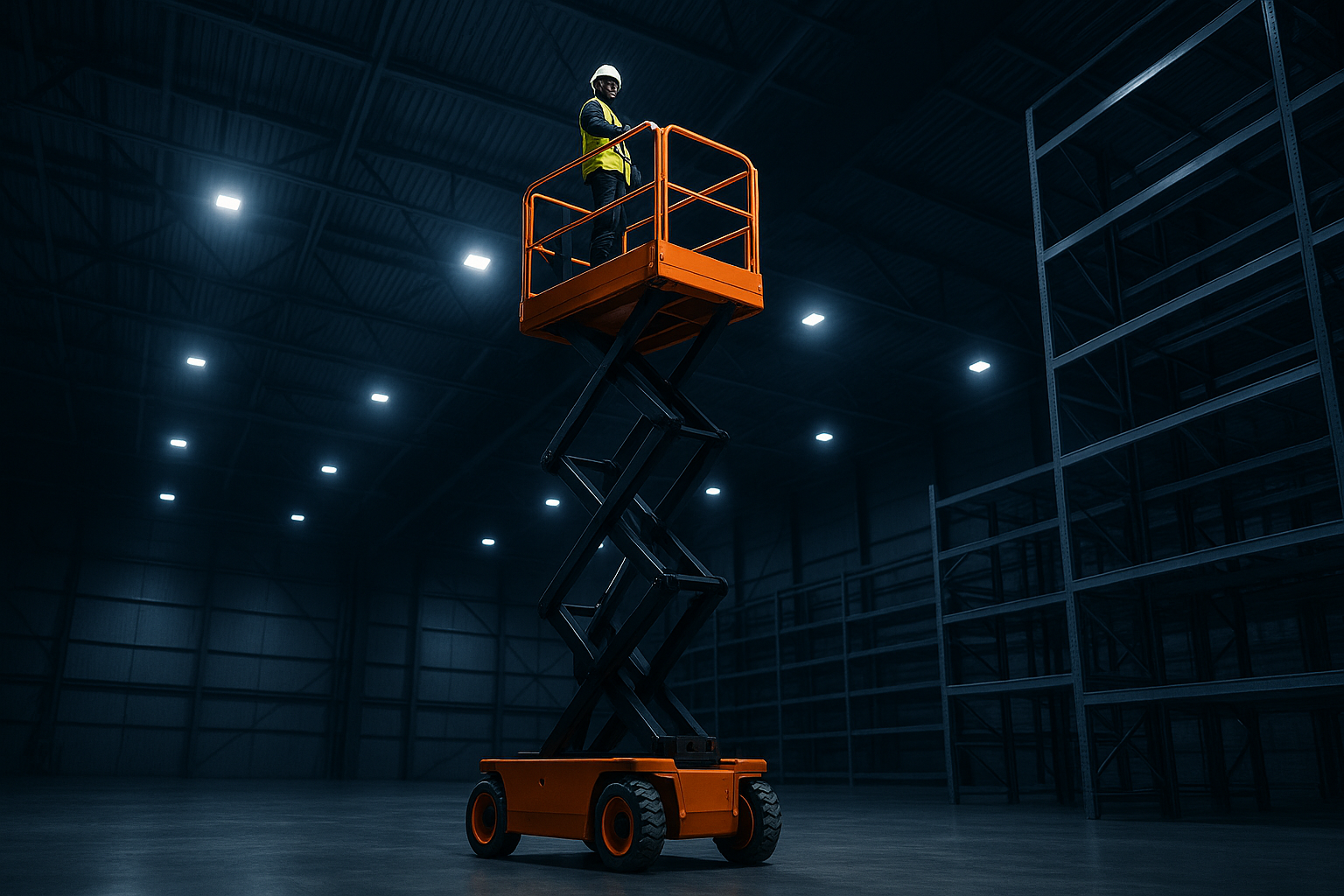
How to Operate a Scissor Lift Safely
A complete guide to pre-start inspection, safe operating procedure, training and certification, and hazard awareness for scissor lift operators.
Hire a Scissor LiftScissor lifts are a practical and widely used form of mobile elevated work platform (MEWP), providing a stable elevated work area for tasks ranging from maintenance and installation to construction and warehousing. Used correctly, they are among the safer options for working at height. Used without proper preparation, training, or situational awareness, they are capable of causing serious injury or death. This guide sets out the steps and knowledge every operator needs before ascending.
Pre-Start Inspection
Before operating a scissor lift, the operator must carry out a documented pre-start inspection on every shift. If any defect or fault is identified, the machine must be taken out of service immediately, tagged, and reported to the responsible person. Do not attempt to operate a machine with known defects.
-
1Check the Operator’s Manual and Risk Assessment Before operating any scissor lift, read the manufacturer’s operator manual for that specific machine. Confirm that a suitable risk assessment and method statement (RAMS) have been prepared and approved for the work. Do not proceed without them.
-
2Carry Out a Walk-Around Visual Inspection Walk the full perimeter of the machine. Check the chassis, scissor arms, platform guardrails, and base frame for visible cracks, deformation, or damaged welds. Inspect entry gates and mid-rails for integrity. Check that all placards and safety labels are legible and in place.
-
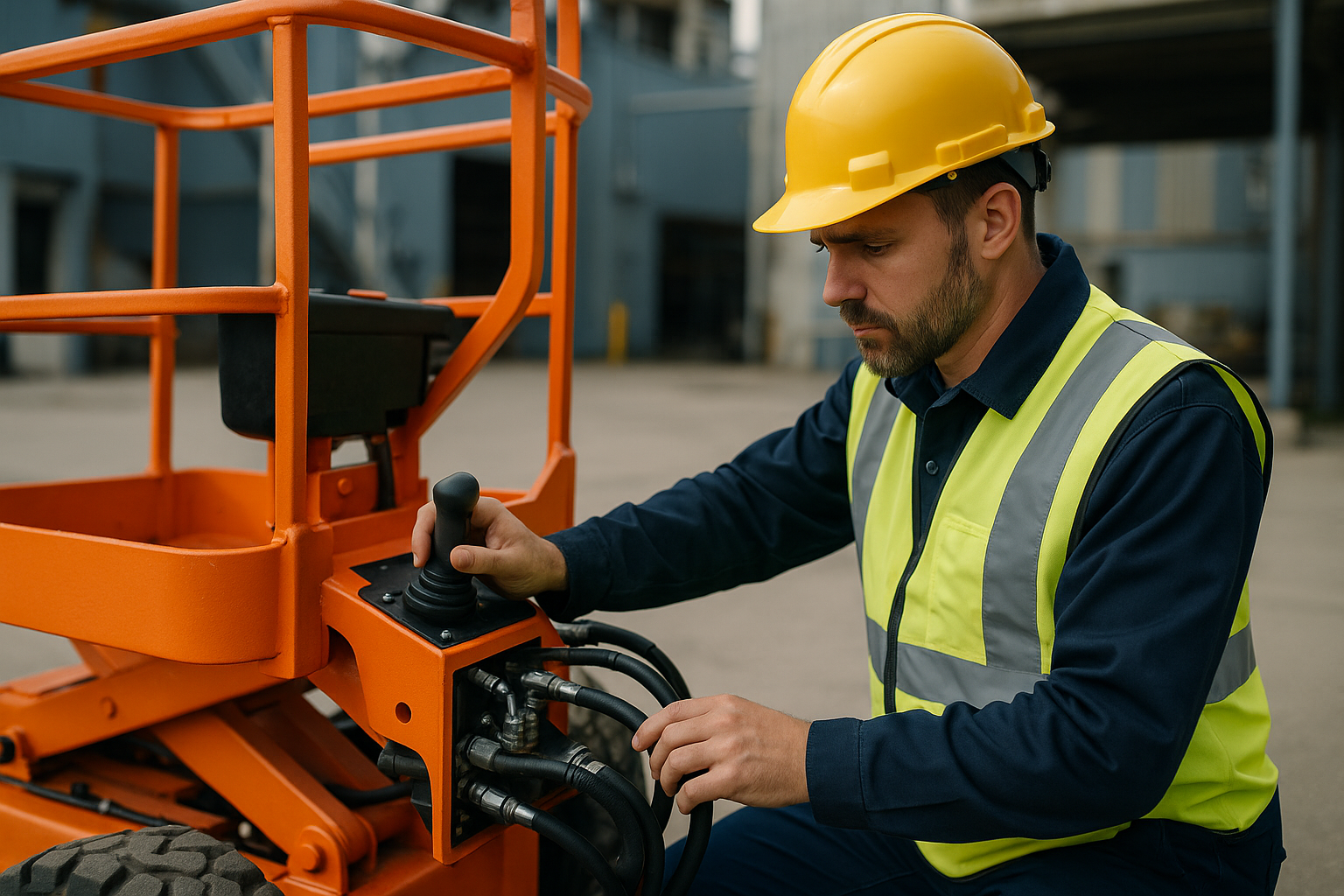
3Inspect Hydraulic System for Leaks Check all hydraulic hoses, cylinders, fittings, and the fluid reservoir for signs of leakage. A machine with active hydraulic leaks must not be operated. Loss of hydraulic pressure while the platform is elevated can result in uncontrolled lowering.
-
4Check Tyres and Wheels Inspect tyres for cuts, damage, foreign objects, or uneven wear. Verify correct tyre pressure where pneumatic tyres are fitted. Check that wheel nuts are secure. Tyre condition directly affects machine stability, particularly on uneven or sloped surfaces.
-
5Confirm Fuel or Battery Charge Level Verify that there is sufficient fuel or battery charge to complete the planned work without interruption. Running out of power while at height may leave the operator unable to lower the platform and require emergency retrieval.
-
6Test All Controls and Safety Devices at Ground Level Before elevating, test all platform and base controls, emergency stop switches, the tilt alarm or sensor, and the emergency lowering function. Confirm the pothole protection bars deploy correctly and that the overload indicator is functional. Do not raise the platform until all devices respond as expected.
-
7Confirm Personal Protective Equipment Ensure you are wearing all required PPE before boarding the platform: safety footwear, high-visibility clothing, and a hard hat where required by site rules. Confirm a full body harness is available and that the anchor point inside the platform is rated for fall arrest use.
-
8Complete and Sign the Pre-Use Inspection Record Record all inspection findings on the machine’s pre-use inspection checklist. Note any defects found, the battery or fuel level, the date, and your name and operator number. This record must be kept as part of the maintenance history and may be required in the event of an incident investigation.
Safe Operating Procedure
Follow these steps in order on every occasion a scissor lift is used. Procedures may vary between machine models — always refer to the manufacturer’s instructions for the specific machine you are operating.
-
1Assess the Work Area Before Positioning Survey the area where the machine will be positioned and operated. Identify overhead obstacles (beams, pipes, sprinklers, cables, and power lines), ground conditions, gradients, and the location of other workers, plant, and traffic. A scissor lift must only be operated on ground that is firm, level, and capable of bearing the machine’s full loaded weight.
-
2Position the Machine and Set Up the Exclusion Zone Drive the machine to the selected position using the ground drive controls. Establish an exclusion zone on the ground around and beneath the work area. No unauthorised persons should enter the exclusion zone while the platform is elevated. Where the work is near a public area or shared traffic route, barriers and signage must be used.
-
3Check Wind Speed and Outdoor Conditions If operating outdoors, confirm that wind speed is within the machine’s rated operating limit. Refer to the placard on the machine for the manufacturer’s stated maximum — this is typically expressed in metres per second or kilometres per hour. Do not operate in wind speeds above the rated limit, during electrical storms, or in other adverse weather that affects safe operation.
-
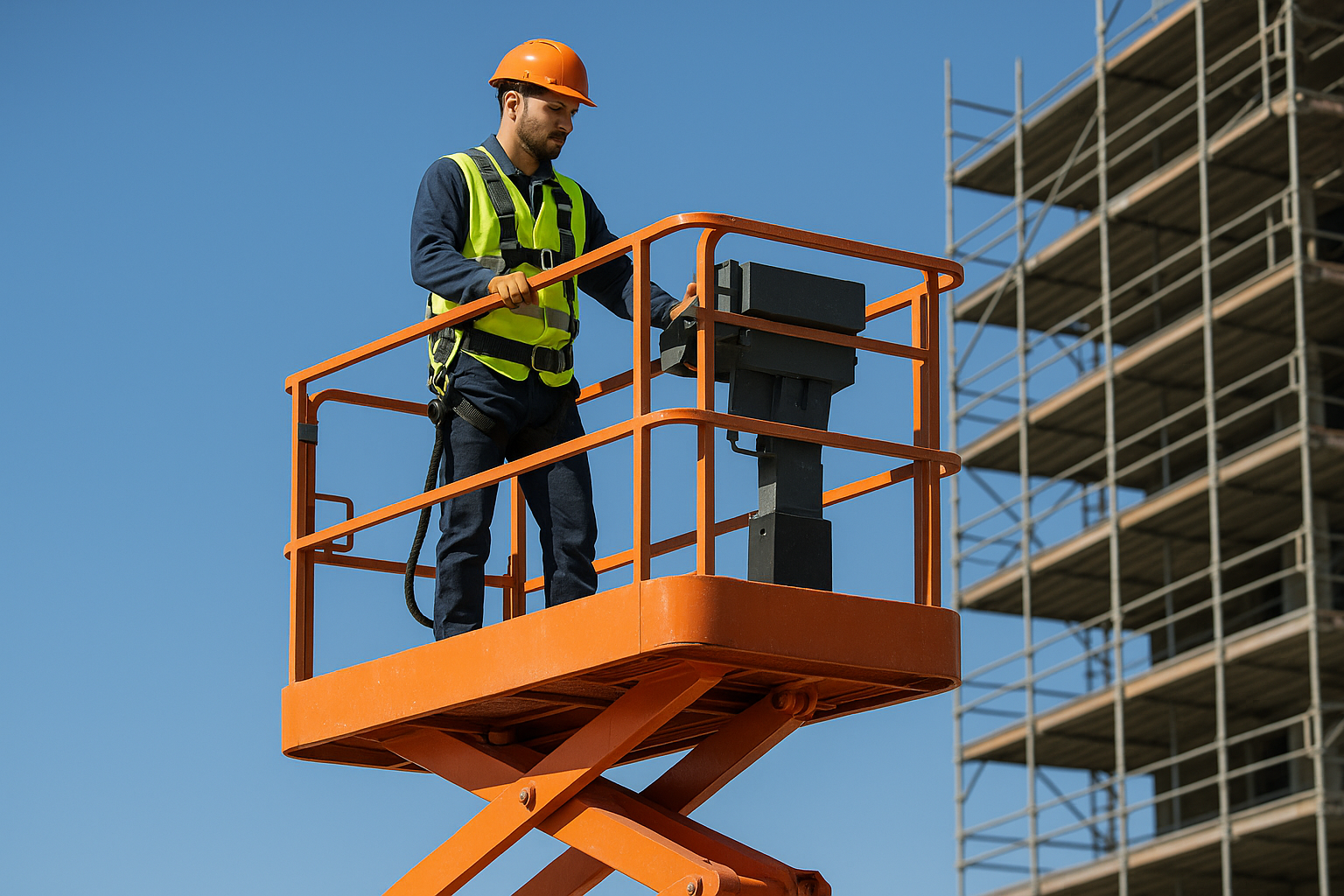
4Board the Platform and Secure the Entry Gate Enter the work platform through the designated entry point. Close and latch the entry gate securely behind you. If a harness is required for the task or by site rules, attach the lanyard to the designated anchor point inside the platform before the platform is raised.
-
5Raise the Platform Smoothly Use the platform controls to raise the scissor lift to the required working height. Apply movements gradually and avoid sudden or jerky inputs. As the platform rises, monitor your clearance from overhead structures, cables, and any other hazards in the vertical path of travel.
-
6Carry Out Work From Within the Platform Conduct all work from within the confines of the platform. Never lean over, reach beyond, or stand on the guardrails. Do not use ladders, boxes, or other objects inside the platform to gain additional height. If the work point cannot be reached safely from within the platform, lower the machine and reposition it.
-
7Observe Rated Platform Capacity at All Times Never exceed the machine’s stated maximum platform load capacity. This figure applies to the combined weight of persons, tools, and materials on the platform at any one time. Overloading reduces stability margins and can cause the machine to tip.
-
8Lower the Platform Before Repositioning When repositioning is needed, lower the platform fully to the travel (stowed) position before driving the machine to a new location. Scissor lifts are not designed for travel with the platform elevated, and doing so significantly increases the risk of tip-over.
-
9Lower, Park, Shut Down, and Secure When work is complete, lower the platform fully to the ground. Drive the machine to a designated parking area on firm, level ground. Return all controls to neutral. Switch off the power. Remove the key or activate the isolation lock. Record any defects noted during operation before handing over or leaving the machine unattended.
Regulations, Training and Certification
Scissor lifts are regulated elevated work platforms. The specific legislation, licensing framework, and training requirements differ between the United Kingdom and Australia. Both frameworks are set out below.
United Kingdom
The Health and Safety Executive (HSE) is responsible for workplace health and safety regulation in Great Britain. Falls from height are the single largest cause of fatal injuries in the workplace: the HSE reports that falls from height consistently account for the greatest number of fatal injuries to workers each year across all industries. The primary legislation governing work at height is the Working at Height Regulations 2005 (WAHR 2005), which applies in Great Britain and applies to all employers and self-employed persons who carry out work at height.
Under the Working at Height Regulations 2005, duty holders must:
Avoid, Prevent, and Minimise
- Avoid work at height where it is reasonably practicable to do so.
- Where work at height cannot be avoided, prevent falls using collective protective equipment such as guardrails and working platforms.
- Where falls cannot be prevented, minimise the distance and consequences of any fall using personal fall protection equipment.
- Ensure that all work at height is properly planned, appropriately supervised, and carried out in a manner that is, so far as is reasonably practicable, safe.
Competence and Equipment
- Ensure that no person engages in work at height unless they are competent to do so, or is being supervised by a competent person while they are being trained.
- Take account of risk assessments when selecting work equipment for use at height.
- Ensure that work equipment, including MEWPs, is maintained in a safe condition and is subject to thorough examination at the intervals specified by legislation.
- Keep records of thorough examinations carried out on lifting equipment under LOLER 1998.
Australia
In Australia, workplace health and safety is regulated at the state and territory level under harmonised Work Health and Safety (WHS) legislation, which is based on the model WHS Act and associated regulations developed by Safe Work Australia. The primary instrument covering elevated work platforms is the model WHS Regulations, specifically the provisions relating to plant and structures and high-risk work licensing.
Operating a boom-type elevated work platform with a boom length of 11 metres or more is classified as high-risk work in Australia, and operators must hold a current High Risk Work Licence (HRWL) in the relevant EWP class (WP) issued by the WHS regulator in their state or territory. Scissor lifts with a maximum working height below 11 metres do not require a HRWL in most Australian jurisdictions, but operators must still be trained and competent.
| Jurisdiction | Regulator | High Risk Work Licence Class (EWP) | Notes |
|---|---|---|---|
| Queensland | Workplace Health and Safety Queensland (WHSQ) | WP — Boom-type EWP (boom 11 m or more) | Issued by WHSQ. Scissor lifts under 11 m: no HRWL required but competency training is mandatory. |
| New South Wales | SafeWork NSW | WP — Boom-type EWP (boom 11 m or more) | Issued by SafeWork NSW. Operators of scissor lifts must be trained and assessed as competent. |
| Victoria | WorkSafe Victoria | WP — Boom-type EWP (boom 11 m or more) | Victorian WHS legislation applies. Competency training required for all EWP operators. |
| Western Australia | WorkSafe Western Australia | WP — Boom-type EWP (boom 11 m or more) | WA operates under its own OSH Act — confirm current requirements with WorkSafe WA directly. |
| South Australia | SafeWork SA | WP — Boom-type EWP (boom 11 m or more) | Harmonised WHS legislation applies. Issued by SafeWork SA. |
| All other states/territories | Respective state/territory WHS regulator | WP — Boom-type EWP (boom 11 m or more) | Always confirm current requirements with the relevant state or territory regulator before operating. |
How to Obtain a HRWL (Australia)
To obtain a High Risk Work Licence for boom-type EWP operation in Australia:
- Complete a nationally accredited training course through a Registered Training Organisation (RTO) delivering the relevant unit of competency (TLILIC0004 or the current unit applicable to your state).
- Pass a practical assessment on a real boom-type EWP with an accredited assessor.
- Submit a licence application to your state or territory WHS regulator, together with the evidence of competency issued by the RTO.
- Carry the HRWL card on your person whenever operating equipment covered by the licence.
Scissor Lift Competency — All Operators
- All scissor lift operators, regardless of HRWL status, must be trained and assessed as competent on the specific type of machine they will be operating.
- Competency must be demonstrated before operating on any worksite, and site inductions must include scissor lift-specific hazards and site rules.
- Refresher training is recommended where an operator has not operated a scissor lift within the previous 12 months.
- Employers must keep records of operator training and competency assessments as part of their plant management system.
Scissor Lift Hazards and How to Control Them
Understanding the most common scissor lift hazards is fundamental to safe operation. The controls described below should be read in conjunction with the site-specific risk assessment for the task.
Falls From the Platform
The most serious hazard. Falls occur when operators lean over guardrails, reach outside the platform, stand on rails, or use objects to gain extra height. Control: remain within the platform at all times. Use a harness and lanyard attached to the platform anchor point when required by site rules or risk assessment.
Tip-Over
Scissor lifts can tip if driven on uneven ground, driven with the platform elevated, overloaded, or positioned on an excessive gradient. Control: operate only on firm, level ground within the manufacturer’s rated slope limits. Never travel with the platform raised. Observe the maximum platform load at all times.
Contact With Overhead Hazards
Overhead structures, beams, pipes, sprinkler systems, and electrical cables present a crushing or electrocution risk when the platform is raised. Control: survey overhead hazards before positioning the machine. Maintain safe clearance distances from live electrical conductors in accordance with the relevant electrical safety authority’s requirements.
Entrapment
An operator can be trapped between the platform and a fixed overhead structure if the platform is raised without checking clearance above. Control: always look up before raising the platform. Identify any overhead structure that falls within the rise path of the machine and the height of the operator.
Ground Instability and Drop-Through
Soft ground, voids, drains, pit covers, or poorly compacted surfaces may fail under the machine’s weight. Contact with ground features such as kerbs or soft fill can cause sudden instability. Control: inspect the ground surface before positioning. Use spreader plates where required. Never position over voids or unsupported covers.
Wind and Adverse Weather
Wind at elevation is often significantly stronger than at ground level. Gusts can destabilise the machine, affect material handling, and create control difficulties. Control: check wind speed before and during operation outdoors. Do not operate if wind speed exceeds the machine’s rated limit. Cease operations immediately if conditions deteriorate.
Collision With Other Plant and Vehicles
Scissor lifts operating in shared work areas are at risk of collision with forklifts, vehicles, or other plant, particularly when driving at ground level. Control: establish clear exclusion zones. Use a spotter where visibility is restricted. Ensure all site traffic management plans account for EWP ground-level travel routes.
Overloading the Platform
Adding tools, materials, or additional personnel beyond the rated platform capacity reduces the machine’s stability margins and may cause structural failure or tip-over. Control: know the maximum rated load for the machine in use. Calculate combined weight of all occupants, tools, and materials before boarding. Never add loads once elevated.
Mechanical or Hydraulic Failure
Failure of hydraulic components or mechanical systems can prevent normal lowering of the platform and may require emergency retrieval of the operator. Control: complete the pre-start inspection before every use. Report defects immediately. Ensure that the emergency lowering procedure has been explained to the operator and is understood before ascending.
After Use: Shutdown and Reporting
Correct shutdown and post-use reporting are part of the operating procedure, not optional add-ons. Defects left unreported create hazards for the next operator and may constitute a breach of legal duty.
-
1Lower and Stow the Platform Return the platform to the fully lowered travel position. Confirm the scissor arms are fully retracted before driving the machine.
-
2Park on Level Ground and Apply the Parking Brake Drive to the designated parking area. Park on firm, level ground. Apply the parking brake before exiting the platform. Confirm the machine is stable before stepping off.
-
3Shut Down and Isolate Switch off the engine or isolate the battery. Return all controls to the neutral or off position. Remove the key or engage the isolation lock to prevent unauthorised use of the machine.
-
4Record and Report Any Defects Record any defects, damage, or abnormal behaviour observed during the shift on the machine’s inspection record. Report defects immediately to the plant manager, site supervisor, or hire company. Tag the machine out of service if a defect could affect safe operation. Never leave defects unreported.
-
5Recharge (Electric Models) For electric scissor lifts, connect the machine to its charger at the end of each shift. Confirm the charge connection is secure and the charger is operating normally. A machine returned with a flat battery creates delays and potential safety issues for the next operator.
Hire a Scissor Lift in Brisbane
Brisbane Scissor Lift Hire stocks electric and diesel scissor lifts for short and long-term hire. All machines are maintained, pre-inspected, and ready for site. Fast delivery across Brisbane and surrounds.
View Scissor Lifts for Hire