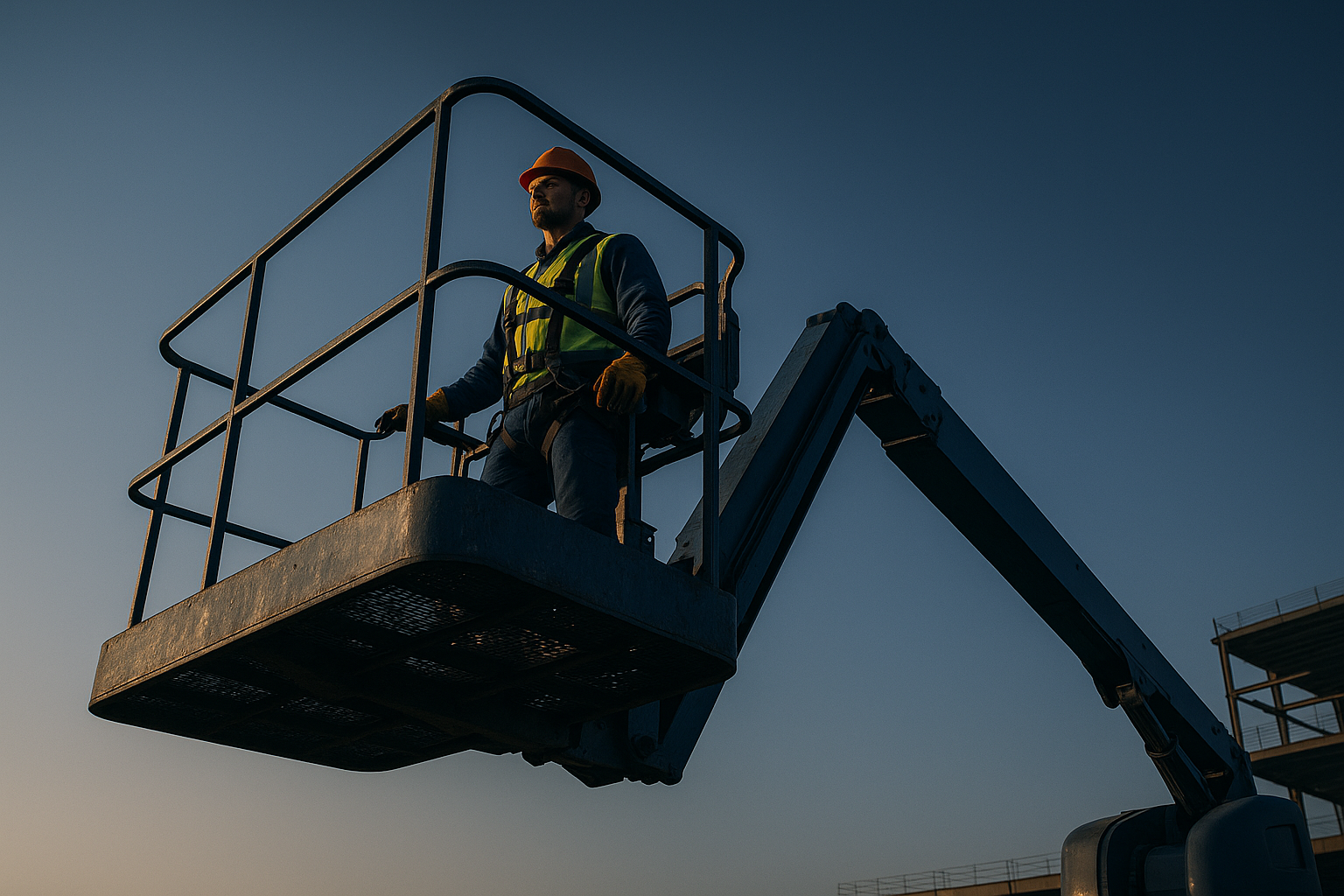
How to Operate a Boom Lift Safely: A Step-by-Step Guide
Falls from elevated work platforms are among the leading causes of workplace fatalities in Australia. According to Safe Work Australia, falls from height consistently rank as one of the top mechanisms of serious injury and death in Australian workplaces, and boom lifts, when operated incorrectly, are a significant contributor to that statistic.
A boom lift (also known as a cherry picker or aerial work platform) is a type of elevated work platform (EWP) that uses a hydraulic boom arm to lift one or more workers to height. Unlike a scissor lift, which moves vertically only, a boom lift provides both vertical and horizontal outreach, making it essential for construction, maintenance, electrical, and painting work.
What Is a Boom Lift? Definition and Types
A boom lift is a mobile elevated work platform that uses an extendable boom arm, powered by a hydraulic system, to raise operators to working height. Boom lifts are mounted on a self-propelled chassis and can be driven to different positions on a worksite, even with the platform elevated in some configurations.
Articulating Boom Lift vs. Telescopic Boom Lift
There are two primary types of boom lifts used in Australia:
An articulating boom lift has multiple jointed sections that bend at pivot points, allowing the boom to reach over obstacles, around structures, and into confined spaces. A telescopic boom lift extends in a single straight line from the chassis, offering greater horizontal outreach but less manoeuvrability around obstacles.
How Is a Boom Lift Different From a Scissor Lift?
A boom lift provides both vertical and horizontal outreach via a rotating, extendable boom arm. A scissor lift raises the platform directly upward using a cross-braced scissor mechanism, it cannot reach horizontally beyond the machine’s footprint. If your work requires positioning above or around an obstacle rather than directly above the machine, a boom lift is the appropriate choice.
Do You Need a Licence to Operate a Boom Lift in Australia?
Yes. In most cases, operating a boom lift in Australia requires either a High Risk Work Licence (HRWL), documented competency training, or both, depending on the machine’s boom length and your state or territory.
Under the national Work Health and Safety framework, a High Risk Work Licence (HRWL) is required to operate any boom-type EWP where the boom length exceeds 11 metres. This licence falls under the EWP (Boom Type) class and is issued by your state or territory WHS regulator. HRWL licences are nationally recognised across all Australian states and territories.
The 11-metre rule is the critical threshold: if the boom, measured from the pivot point at the base of the boom to the platform, exceeds 11 metres, you must hold a current HRWL before operating the machine.
Boom Lift Licence Requirements by State and Territory
What If the Boom Is Under 11 Metres?
If the boom length is 11 metres or under, a formal HRWL is not required. However, documented competency training is still legally required under Australian WHS and OHS legislation. You must be able to demonstrate, with a Statement of Attainment or equivalent documentation, that you have been trained to operate the specific type of machine.
Under Safe Work Australia’s Code of Practice: Managing the Risk of Falls at Workplaces, operators of all EWPs must be competent and the person conducting the business or undertaking (PCBU) must ensure this competency is verified and documented. Employers cannot simply assign an untrained worker to a boom lift regardless of its size.
Required Safety Equipment for Boom Lift Operators
Boom lift operators in Australia are required to wear specific personal protective equipment (PPE) and use safety devices to comply with workplace health and safety laws. The following checklist applies to the vast majority of boom lift operations across all Australian states and territories.
Mandatory PPE Checklist
Full-body harness: mandatory; must be worn and attached to the designated anchor point inside the platform at all times during operation
Shock-absorbing lanyard: connects the harness to the boom lift anchor point; must be correctly rated and inspected before use
Hard hat / safety helmet: protection from falling objects and overhead hazards
High-visibility vest: required on construction sites and most commercial worksites
Safety boots (steel-capped): mandatory on all construction and industrial sites
Safety glasses / eye protection: required for outdoor work, overhead tasks, and wherever debris is a risk
Gloves: recommended for grip, hand protection, and protection from abrasion
Equipment Safety Checks (Machine-Side)
Before entering the platform, confirm the following machine-side safety systems are functional:
Fall arrest anchor points inside the basket are undamaged and correctly rated
Working Load Limit (WLL) placard is visible, legible, and has not been exceeded by the planned load
Emergency lowering device location is confirmed, ground crew must know how to use it
Ground fault circuit interrupter (GFCI) is in place where electrical work is being performed
Pre-Operation Inspection Checklist
Before every use, boom lift operators must complete a documented pre-operation inspection. This is a legal requirement under Australian WHS regulations and a critical step in preventing accidents. The inspection must be completed even if the machine was used the previous day, conditions and equipment status can change between shifts.
Pre-Operation Inspection: 10-Point Checklist:
Review the operator manual: confirm you are familiar with the specific model being used, including its rated capacity, gradient limits, and wind speed restrictions
Check fluid levels: inspect engine oil, hydraulic fluid, coolant, and fuel level (or battery charge state for electric models)
Inspect tyres or tracks: check for visible damage, correct inflation (pneumatic tyres), and wear
Test all controls: test both ground-level controls and platform controls before elevating; confirm all functions respond correctly
Inspect the work platform / basket: check for cracks, damage, loose bolts, and floor integrity; confirm the gate or entry chain is functional
Inspect all safety devices: test emergency stop buttons, tilt sensors, and load sensors; confirm warning indicators function correctly
Check outriggers / stabilisers: ensure they deploy correctly, lock into position, and retract fully
Inspect the boom and hydraulic system: look for hydraulic fluid leaks, damaged hoses, bent cylinders, or cracked welds
Verify fall arrest equipment: inspect harness condition, check lanyard for damage, and confirm the anchor point inside the basket is secure
Assess the work environment: identify overhead hazards (powerlines, structures), evaluate ground conditions (soft ground, slopes, underground services), and establish exclusion zone boundaries
Operators must document each inspection using a pre-start checklist form. If a defect is identified, the machine must be tagged out of service and not used until it has been inspected and cleared by a competent person.
How to Operate a Boom Lift Safely: Step-by-Step
Once you have completed your pre-operation inspection and confirmed you hold the appropriate licence or competency certification, follow these steps to operate a boom lift safely.
Step 1: Set Up the Work Zone
Establish a clearly defined exclusion zone around the machine before operation begins. In most cases, this is a minimum of 6 metres from the machine’s perimeter, or as specified in your site safety plan. Place physical barriers (witches’ hats, bunting, or hard barriers) and post appropriate signage.
Identify all overhead hazards before elevating, in particular, overhead powerlines. Safe Work Australia specifies minimum safe approach distances that must be maintained between any part of the boom lift and live electrical infrastructure. Engage a spotter where required by the site safety plan or where visibility is limited.
Step 2: Position the Machine
Select firm, level ground for machine placement wherever possible. If operating on an incline, confirm the slope does not exceed the manufacturer’s rated gradient, do not estimate, check the manual.
Deploy outriggers and stabilisers in accordance with the manufacturer’s instructions, ensuring each outrigger pad is positioned on solid, load-bearing ground. Confirm ground bearing capacity is adequate, soft ground, underground voids, and drainage infrastructure can all cause instability or tip-over. If in doubt, consult a structural engineer or site manager.
Step 3: Enter the Platform Safely
Mount the platform using three points of contact at all times. Do not step over the guardrail or use the boom arm as a handhold. Once inside the platform, immediately attach your harness lanyard to the designated anchor point before initiating any machine movement.
Close and secure the platform gate or entry chain before elevating.
Step 4: Conduct a Ground-Level Control Test
Before elevating, test all boom functions from the ground-level controls. Confirm the emergency lowering function is operational and that at least one trained ground operator knows how to use the ground controls to lower the platform in an emergency.
This step is critical: if an operator becomes incapacitated in the platform, the ground crew must be capable of recovering them safely.
Step 5: Elevate and Position the Boom
Use slow, controlled inputs when raising and positioning the boom. Avoid sudden or jerky movements, particularly near full extension or when operating close to structures.
Maintain constant awareness of overhead and lateral clearances as the boom moves. Do not exceed the Working Load Limit (WLL) of the platform, this includes the combined weight of operators, tools, and materials. Keep both feet flat on the platform floor at all times. Never stand on guardrails, tool trays, or any attachment.
Maintain communication with ground crew throughout the operation using two-way radio or pre-agreed hand signals.
Step 6: Perform the Work
Remain within the confines of the platform at all times. Do not reach beyond the guardrail, repositioning the machine is always preferable to overreaching. Never attach external loads to the boom or use the lift as a crane.
Monitor weather conditions continuously. Cease operation immediately if wind speed exceeds the manufacturer’s rated limit, for most boom lifts, this is 45 km/h. Do not operate during thunderstorms or in conditions where lightning is a risk.
Step 7: Lower and Stow the Boom
When work is complete, return the boom to the fully stowed (travel) position before moving the machine. Lower the platform completely before dismounting.
Disengage and fully retract all outriggers and stabilisers. Turn off the machine, engage all travel locks, and remove the key from the ignition.
Step 8: Post-Operation Checks
Document any faults, damage, unusual sounds, or near-miss incidents in the machine log before the next operator uses the equipment. Do not leave defects unreported, report all issues to your supervisor immediately and tag the machine out of service if there is any safety concern.
Remove the key and secure the machine against unauthorised access if it is being left unattended on site.
Common Boom Lift Hazards and How to Avoid Them
Understanding the specific risks associated with boom lift operation is essential for every operator. The following hazards account for the majority of serious incidents and fatalities involving EWPs in Australia.
How to Get Trained and Licensed to Operate a Boom Lift in Australia
To legally operate a boom lift with a boom exceeding 11 metres in Australia, you must obtain a High Risk Work Licence (HRWL) – EWP (Boom Type). The pathway to obtaining this licence involves four steps:
HRWL licences are nationally recognised, meaning a licence issued in Queensland is valid for operation in Western Australia, Victoria, or any other state or territory.
What If the Boom Is Under 11 Metres?
For boom lifts under 11 metres, operators must complete a recognised EWP operator training course through an RTO and retain their Statement of Attainment as evidence of competency. While an HRWL is not required, this documentation must be available for inspection on site.
What Training Units Are Required?
The nationally recognised unit of competency for boom-type EWP operation is:
This unit is delivered by RTOs across Australia and covers both theory (regulations, hazard identification, pre-operation procedures) and practical assessment (hands-on machine operation). Contact an accredited RTO or your state WHS regulator to find approved training providers in your area.
Need a Boom Lift for Your Project?
Speak with the Brisbane Scissor Lift Hire team about the right boom lift for your site, working height and access requirements.
Get a Quote