Telehandler Safety: Key Rules Every Operator Must Know
Telehandlers are powerful, versatile machines used daily across construction, roofing, steelwork, and logistics sites. They can lift heavy loads to significant heights, which makes them genuinely useful and genuinely dangerous when operated incorrectly. This guide covers the key telehandler safety rules every operator must know, including licence requirements, pre-start inspection steps, load capacity rules, and common worksite hazards. Whether you operate a telehandler regularly or plan to hire one, this information applies to you.
What Is a Telehandler and Why Does Safety Matter?
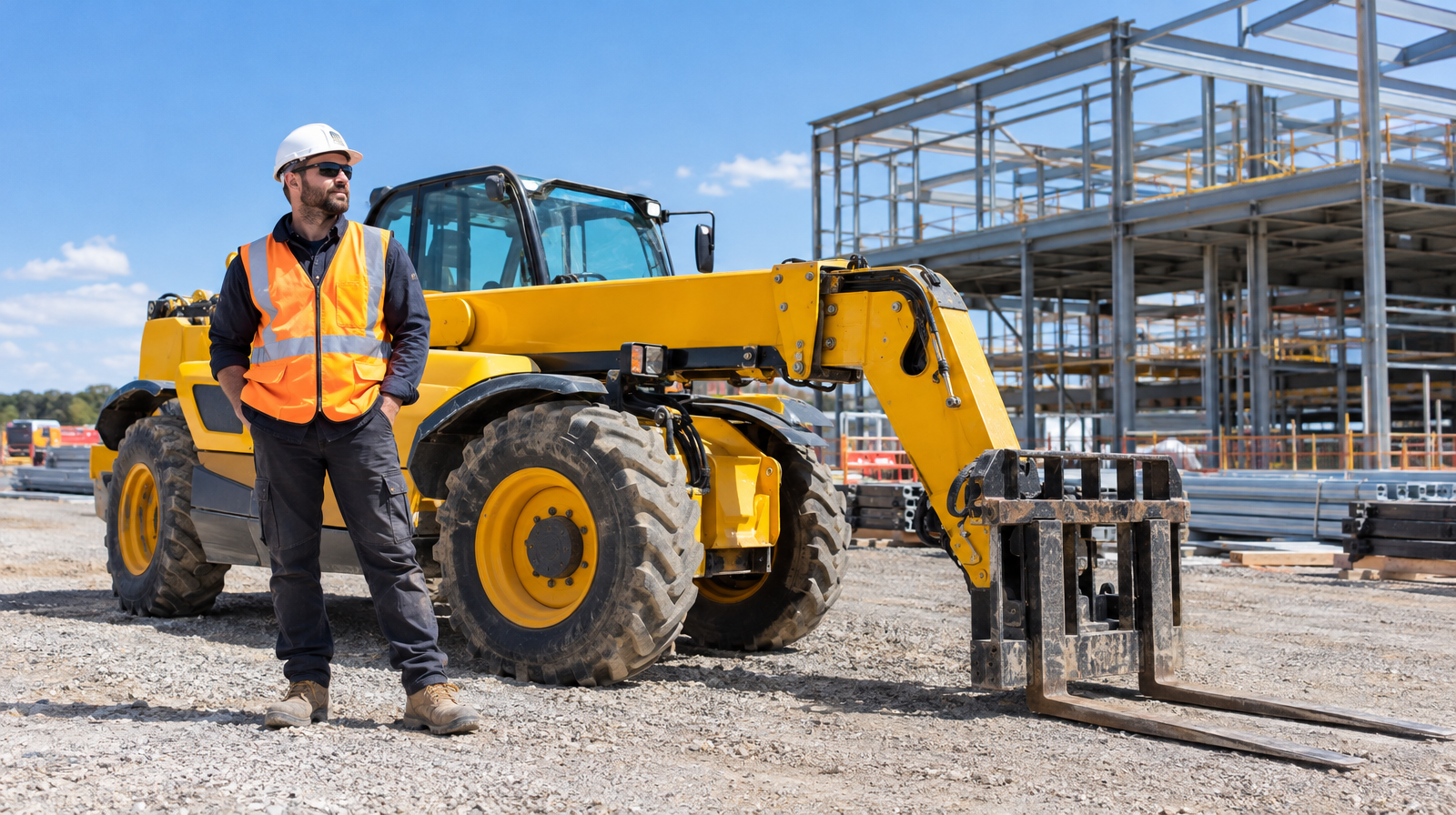
A telehandler, also called a telescopic handler, is a rough-terrain lifting machine fitted with an extendable boom arm that can carry attachments such as forks, buckets, or personnel cages.
A telehandler can extend its boom outward and upward at the same time, giving it the reach and height a conventional forklift cannot match. Telehandler incidents are a significant concern on Australian worksites. Tip-overs, crush injuries, falling loads, and collisions with pedestrians all occur when safety rules are not followed.
Under Australian Work Health and Safety (WHS) legislation, employers and operators both carry legal obligations to ensure telehandlers are operated safely. Failing to meet those obligations can result in serious injuries, fatalities, regulatory investigations, and significant legal consequences.
What Licence Do You Need to Operate a Telehandler in Australia?
In Australia, most telehandlers are classified as forklift trucks under the model WHS Regulations, which means operators are required to hold a High Risk Work (HRW) licence with an LF (Forklift Truck) class endorsement.
This classification generally applies to telehandlers with a load capacity of one tonne or more. Safe Work Australia sets the national framework for HRW licensing. State and territory regulators including Workplace Health and Safety Queensland, WorkSafe Victoria, and SafeWork NSW administer the licences and handle applications, renewals, and compliance.
To obtain an LF license, operators must complete accredited training with a registered training organization and pass a practical assessment. Holding a licence for a standard counterbalance forklift does not automatically qualify you to operate a telehandler. Operators must be trained on the specific telehandler model they intend to use, in addition to holding the correct licence class.
All workers on construction sites in Australia must also hold a White Card (General Construction Induction Card), regardless of their role or the equipment they operate.
Licensing requirements at a glance:
| Requirement | Standard Forklift | Telehandler (1t+ capacity) |
|---|---|---|
| HRW Licence class | LF (Forklift Truck) | LF (Forklift Truck) |
| White Card required on construction sites | Yes | Yes |
| Model-specific training required | Yes | Yes |
| Additional ticket for personnel lifting | No | Yes, where applicable |
| State regulator administers licence | Yes | Yes |
Unlicensed operation of a telehandler on an Australian worksite is a breach of WHS obligations and carries serious legal consequences for both the operator and the person conducting the business or undertaking (PCBU). Contact your state regulator or visit safework.gov.au for current licensing information.
Key Safety Rules Every Telehandler Operator Must Follow
The following rules apply to every telehandler operator on every Australian worksite, regardless of experience level or machine type.
- 1Check your licence and training before you operateYou must hold the correct HRW licence for the machine class. You must also have completed training on the specific telehandler model you are using. Do not assume that experience with one brand or model transfers automatically to another.
- 2Complete a pre-start inspection every shiftWalk around the machine before starting it. Inspect the boom, forks or attachments, tyres, fluid levels, seatbelt, controls, and alarms. Log any defects in the plant register and do not operate a faulty machine. Pre-start inspections are a legal requirement under WHS obligations, not optional.
- 3Know the load chart and never exceed rated capacityLoad capacity changes as the boom extends and rises. A telehandler may be rated to lift two tonnes with the boom retracted but significantly less at full extension. The load chart is displayed in the cab. Read it before every lift. Overloading is a leading cause of telehandler tip-overs.
- 4Assess and prepare the ground before liftingConfirm that the ground is stable, level, and capable of supporting the machine and its load. Deploy stabilisers or outriggers where the machine is fitted with them. Avoid soft ground, slopes that exceed the manufacturer’s rated angle, and surfaces with underground voids or service trenches.
- 5Keep loads low during travelCarry the load as close to the ground as safely possible when moving the machine between locations. Travelling with a raised boom significantly increases the risk of tip-over.
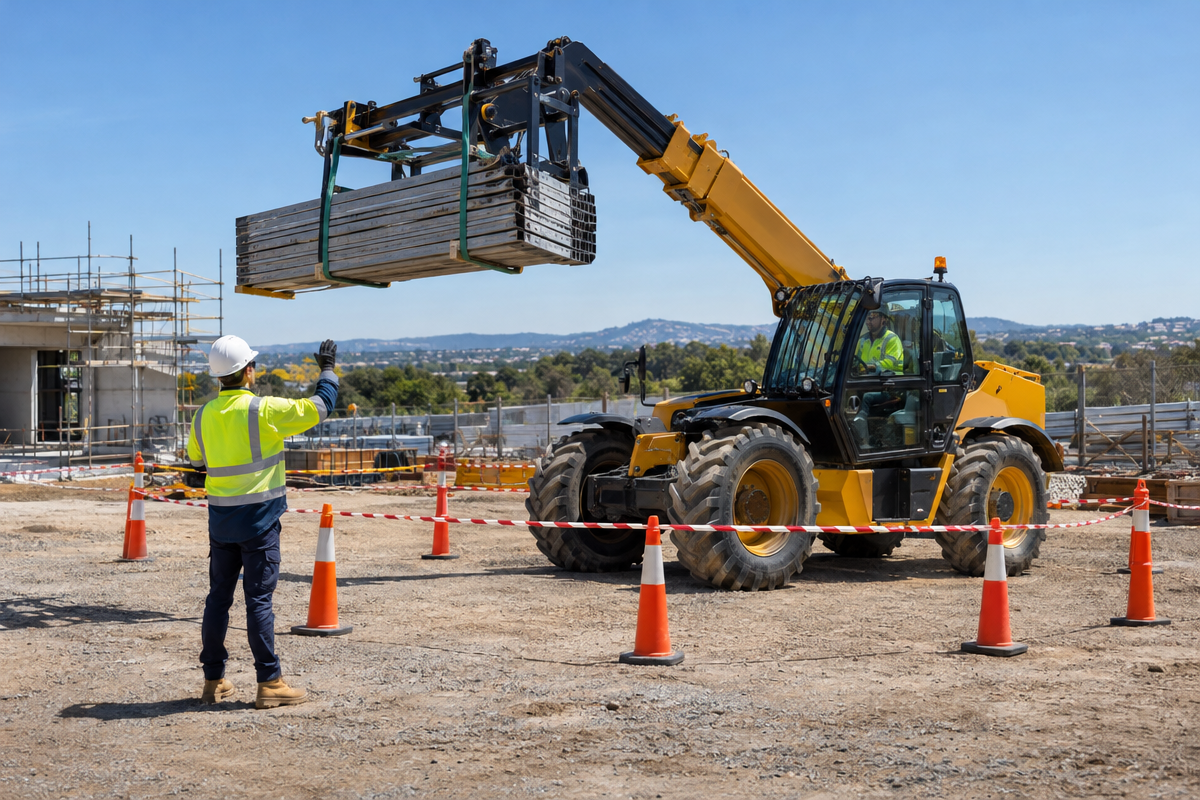
- 6Establish and maintain exclusion zonesNo unauthorized personnel should be within the machine’s working radius during lifting operations. Clearly mark exclusion zones before work begins. Keep ground workers clear of any area where a dropped or shifted load could cause harm.
- 7Never use a telehandler as an EWP without the correct attachment and authorisation.Use a personnel cage only where the manufacturer specifically approves it for that machine. A separate risk assessment is required before lifting people. Additional assessment or permit requirements may apply. Never improvise a personnel lifting solution with a telehandler.
- 8Operate within your line of sightMove the machine or raise the boom only when you have a clear, unobstructed view. Use a spotter when the load, terrain, or work environment restricts your visibility. Establish clear communication signals with your spotter before starting.
- 9Shut down safely at the end of every shiftLower the boom fully, engage the park brake, remove the ignition key, and secure the machine. Do not leave a telehandler unattended with the boom raised or the engine running.
- 10Follow all site-specific rules and permit-to-work requirementsSome worksites impose additional controls for telehandler operation, particularly near overhead power lines, in confined spaces, adjacent to excavations, or in areas with public access. Always check the site safety plan before operating.
Pre-Start Inspection Checklist for Telehandler Operators
Operators must complete a pre-start inspection at the start of every shift. Do not start the machine until you complete all checks and assess any faults.
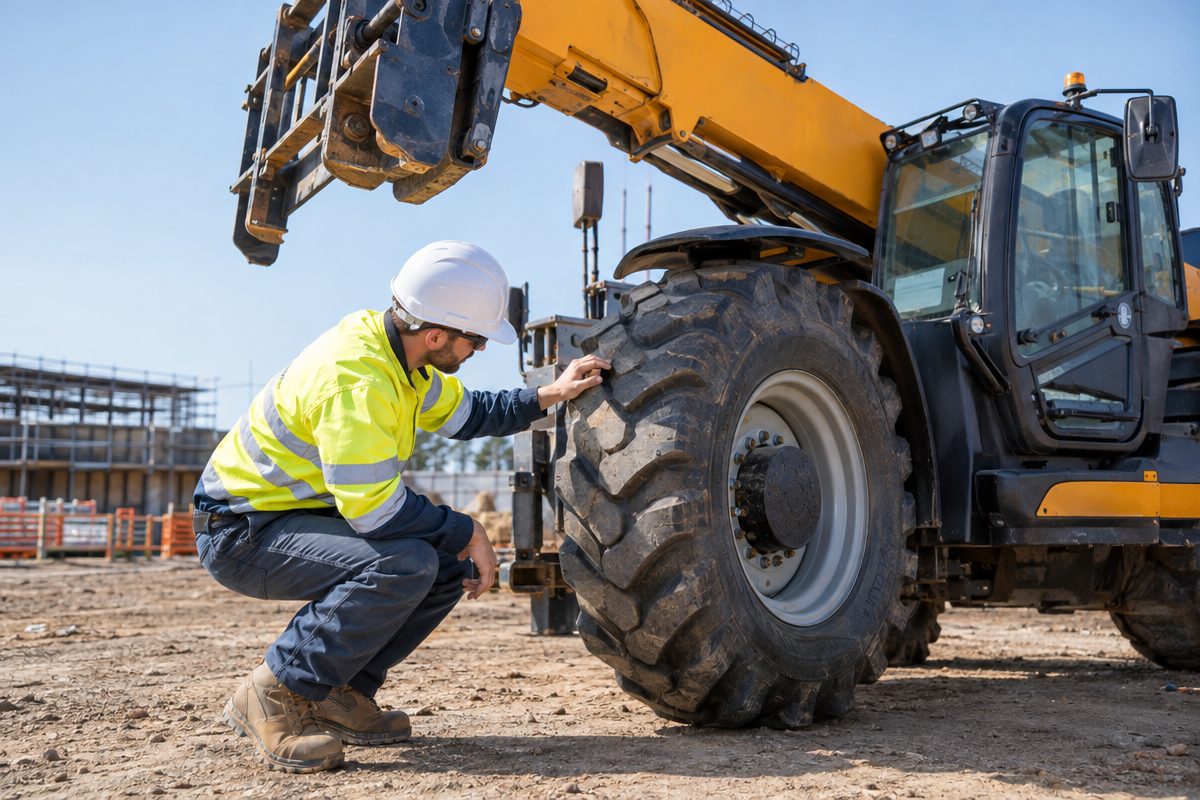
If you identify a fault during the pre-start inspection, record it, report it to your supervisor, and take the machine out of service until a competent person has assessed and repaired it.
Telehandler vs Forklift: Key Differences Operators Need to Know
A telehandler and a forklift are both classified as forklift trucks under Australian WHS Regulations if they meet the capacity threshold, but they are very different machines in practice.
| Feature | Standard Forklift | Telehandler |
|---|---|---|
| Boom type | Fixed mast | Extendable telescopic boom |
| Operating terrain | Hardstand, warehouse floors | Rough terrain, construction sites |
| Maximum height | Typically 3 to 7 metres | Up to 17 to 20 metres depending on model |
| Forward reach | Minimal | Significant — can place loads beyond the machine footprint |
| Licence class (Australia) | LF | LF (same class, but model training required) |
| Common attachments | Forks, clamps | Forks, buckets, augers, personnel cages |
| Ground pressure | Higher (narrower base) | Wider base, designed for uneven ground |
| Tip-over risk factors | Lateral stability, load weight | Load weight, boom extension, ground conditions |
Holding a standard forklift licence (LF class) may satisfy the licence requirement for a telehandler of equivalent classification, but it does not replace the need for model-specific training. The operational differences are substantial. A person trained only on warehouse forklifts is not prepared to safely operate a telehandler on a construction site without further training on that machine type.
Common Telehandler Hazards on Australian Worksites
Understanding the hazards associated with telehandler operation is essential for operators and site supervisors alike.
- Tip-over:The most serious and most common telehandler incident type. Caused by overloading, operating on unstable or sloped ground, or exceeding boom extension limits.
- Overhead powerline contact:Raising the boom near overhead powerlines is extremely dangerous. Always observe safe approach distances. Check for overhead lines before any lift.
- Pedestrian collision:Ground workers struck by moving telehandlers are a significant cause of serious injuries on construction sites. Exclusion zones and spotters reduce this risk.
- Falling loads:Loads that are not properly secured or that exceed rated capacity can fall during travel or lifting, causing injury or death to anyone below.
- Slope and gradient failures:Operating on gradients that exceed the manufacturer’s rated limits can cause tip-over with little warning.
- Attachment failure:Using damaged, incorrect, or poorly fitted attachments can result in catastrophic load drop. Always confirm attachments are rated for the task and correctly locked.
- Operator fatigue:Long shifts, night work, and repetitive tasks increase the risk of operator error. Supervisors must monitor fatigue risk.
- Poor ground conditions:Mud, wet gravel, and loose fill can shift under the machine’s weight, particularly during extended lifts. Always assess the ground before lifting.
Frequently Asked Questions About Telehandler Safety
Do you need a licence to operate a telehandler in Australia?
Can a forklift licence be used for a telehandler?
What training do telehandler operators need?
What should you do if you find a fault during a pre-start inspection?
Are there height restrictions for telehandler operation on worksites?
Can a telehandler be used to lift people?
What is a load chart and why does it matter?
Who is responsible for telehandler safety on a construction site?
Need a Telehandler for Your Project?
Speak with the Brisbane Scissor Lift Hire team about the right machine for your site.
Get a Quote