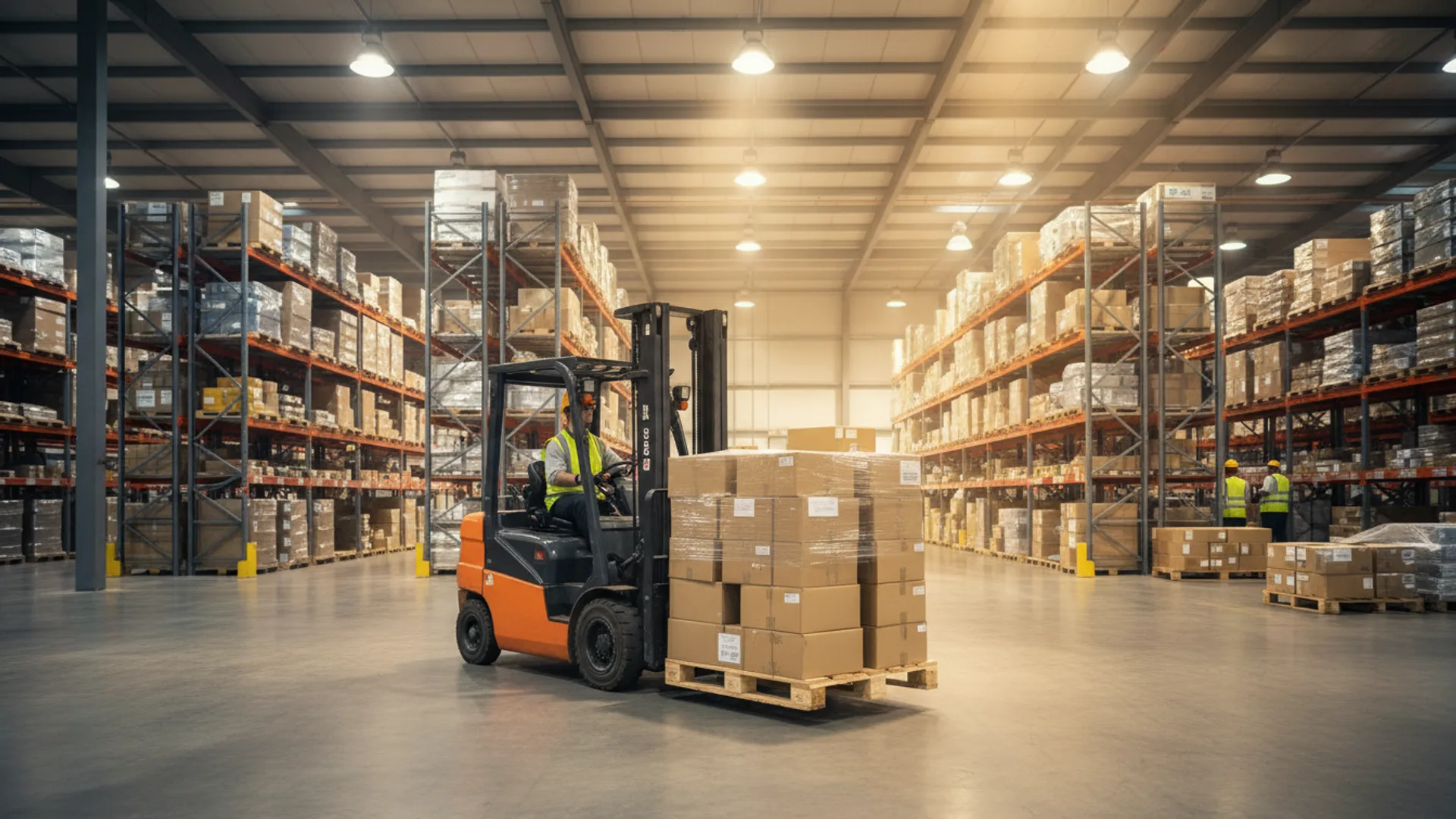
Forklift Buyer’s Guide
What Type of Forklift Do You Need? A Buyer’s Guide
Choosing the right forklift comes down to five key factors: load capacity, operating environment, lift height, aisle width, and fuel type. Work through each one clearly, and the right equipment choice becomes obvious.
Get a QuoteIf you’ve ever stood in a warehouse trying to decide between a reach truck and a counterbalance forklift, or searched online only to drown in technical jargon, you’re not alone. Choosing the right forklift is one of the most consequential equipment decisions a business can make, and the consequences of getting it wrong range from wasted capital to genuine safety risk.
The good news: the decision is far more systematic than it appears. Choosing the right forklift comes down to five key factors: load capacity, operating environment, lift height, aisle width, and fuel type. Work through each one clearly, and the right equipment choice becomes obvious.
This guide walks through every factor in plain language, covering forklift types, how to calculate the capacity you actually need, safety features worth prioritising, and practical advice for small businesses buying their first unit. Whether you’re outfitting a small warehouse, replacing aging equipment, or sourcing machinery for a construction site, this guide gives you the framework to decide with confidence.
The 5 Key Factors for Choosing the Right Forklift
Before comparing specific models or fuel types, you need to answer five fundamental questions about your operation. These factors act as a decision filter — each one narrows the field until the right choice becomes clear.
Load Capacity: How Much Do You Need to Lift?
Rated capacity is the maximum load a forklift can safely carry at a specified load centre, typically measured at 500mm (24 inches) from the front face of the forks. This is one of the most misunderstood specifications in the industry.
Here’s the critical point most buyers miss: a forklift’s rated capacity decreases as the load centre distance increases. If your load is unusually deep or irregularly shaped, its centre of gravity shifts further from the forks, and the effective safe capacity drops accordingly. Always check the capacity plate — it shows how rated capacity changes at different load centre distances.
A simple rule of thumb for sizing: take the weight of your heaviest regular load, then add a 20% safety buffer. That figure is your minimum rated capacity. Buying a forklift rated exactly at your load limit is a safety and productivity risk — equipment that operates constantly near its maximum is under greater mechanical stress and leaves no margin for irregularly shaped or denser-than-expected loads.
Also factor in attachments. Clamps, rotators, and side-shift booms all add weight and shift the load centre, reducing effective capacity. If attachments are part of your operation, account for them before finalising your capacity requirement.
Operating Environment: Indoor, Outdoor, or Both?
Where your forklift operates determines nearly everything else about what you can safely buy.
Indoor environments on smooth, sealed concrete are ideal for electric forklifts. Zero emissions matter in enclosed spaces — cold storage, food production, and pharmaceutical warehouses often mandate electric equipment. Smooth floors also mean narrower tyres and tighter turning radii are viable.
Outdoor environments on sealed yards typically suit LPG or diesel counterbalance forklifts. Rough, unsealed, or uneven terrain — construction sites, agricultural properties, landscaping operations — requires rough terrain forklifts or telehandlers with pneumatic tyres and adequate ground clearance.
Mixed operations (moving between a warehouse and an outdoor sealed yard) are where LPG counterbalance forklifts earn their reputation. LPG produces lower emissions than diesel and is suitable for brief periods indoors with adequate ventilation, making it the most flexible fuel choice for businesses that work across both environments.
One important caution: diesel forklifts should never be operated in enclosed or poorly ventilated spaces without exhaust extraction. And rough terrain forklifts, conversely, can cause floor damage if brought indoors onto smooth surfaces.
Lift Height: How High Do You Need to Reach?
Lift height requirements determine your mast configuration — the vertical structure that raises and lowers the forks.
Match your mast to your warehouse racking height, and add clearance for pallet height and fork thickness when calculating your required lift. Note that lift height also affects stability — a load lifted to full height raises the combined centre of gravity, which is why speed and cornering behaviour must change at elevation.
Aisle Width: How Tight Is Your Space?
Aisle width is a constraint buyers frequently underestimate until equipment arrives on site. Measure your tightest aisle and turning area before purchasing — it’s a step that saves significant cost and frustration.
Standard Aisle
Standard counterbalance forklifts require approximately 3.5m of aisle width to operate and turn safely
Narrow Aisle
Narrow aisle reach trucks are designed for aisles of 2.5–2.8m, significantly improving racking density
Very Narrow Aisle
Very Narrow Aisle (VNA) trucks operate in aisles under 1.8m and typically run on guide rails or wire guidance systems
If your floor plan supports narrower aisles, upgrading to a reach truck or VNA solution can dramatically increase your storage capacity — sometimes by 40–50% — without expanding your building footprint.
Power Source: Electric, LPG, or Diesel?
| Power Source | Best Environment | Emissions | Running Cost | Upfront Cost | Refuel/Recharge Time |
|---|---|---|---|---|---|
| Electric | Indoor, smooth surfaces | Zero direct | Lowest | Higher | 6–8 hrs charge (or battery swap) |
| LPG | Indoor/outdoor sealed surfaces | Low–moderate | Moderate | Moderate | Minutes (cylinder swap) |
| Diesel | Outdoor, heavy-duty | Higher | Moderate–high | Moderate | Minutes |
Electric forklifts have higher purchase prices but significantly lower running costs over a 5+ year lifecycle. For operations running single shifts, they are often the most cost-effective choice long-term. For multi-shift operations, battery management and charging infrastructure require careful planning or investment in fast-charge or battery swap systems.
LPG remains the most popular choice for small-to-medium businesses due to its flexibility, predictable fuel costs, and fast refuelling. Diesel suits outdoor heavy-duty work where power and runtime are priorities.
Types of Forklifts Explained: Which One Is Right for You?
There are seven main types of forklifts, each designed for specific environments and tasks. Here’s what each one does and who it’s best suited for.
Counterbalance Forklift
The counterbalance forklift is the most common type used worldwide, and for good reason. It features forks at the front and a counterweight at the rear — no outrigger legs — which allows it to drive directly up to a load without obstruction.
For most businesses buying their first forklift, a counterbalance model is the default recommendation because of its versatility across load types, surfaces, and environments.
Reach Truck
Unlike a counterbalance forklift, a reach truck is designed for narrow aisles and cannot be used outdoors. Its extendable mast allows the forks to reach forward into racking, then retract, enabling operation in aisles as narrow as 2.5m while accessing high-bay shelving.
Pallet Jack / Walkie Stacker
The entry point for businesses that don’t need full forklift capability. Electric walkie stackers can lift pallets to moderate heights; manual pallet jacks move loads at ground level only.
Order Picker
In an order picker, the operator elevates with the load, allowing precise selection of individual items from shelving at height. This differs from a standard forklift where the operator remains at ground level.
Rough Terrain Forklift
For outdoor construction sites, a rough terrain forklift is the correct tool. Featuring four-wheel drive, large pneumatic tyres, and high ground clearance, these machines are built to operate safely on uneven ground, gravel, mud, and grass — conditions that would be dangerous or impossible for standard forklifts.
Telescopic Handler (Telehandler)
A telehandler features an extendable boom arm rather than a fixed vertical mast, providing both vertical height and horizontal reach simultaneously. This versatility allows telehandlers to replace cranes on many construction sites at a fraction of the cost. They can be fitted with forks, buckets, work platforms, and other attachments to suit a wide range of tasks.
Side Loader
A side loader carries loads in a side-mounted cradle rather than on front-facing forks, allowing it to travel down narrow aisles with long loads without turning.
How to Calculate the Forklift Capacity You Need
To determine the forklift capacity you need, measure the weight of your heaviest regular load and account for the load centre — the distance from the front face of the forks to the load’s centre of gravity. Follow these steps:
-
1Identify your maximum load weight: Weigh your heaviest pallet or item, not an average load
-
2Measure your load’s dimensions: Length, width, and height all affect the load centre calculation
-
3Calculate the load centre: For a standard rectangular load, the load centre is typically half the load depth (front to back)
-
4Check the manufacturer’s capacity plate: This shows how rated capacity changes at different load centre distances; if your load centre exceeds the standard 500mm, effective capacity is reduced
-
5Add a 20% safety buffer: Multiply your maximum load weight by 1.2 to determine your minimum rated capacity
-
6Factor in attachments: Each attachment reduces rated capacity; confirm the de-rated capacity with your supplier before purchase
| Application | Typical Load Weight | Recommended Minimum Rated Capacity |
|---|---|---|
| Retail / Small Warehouse | Up to 1,000kg | 1,500kg |
| General Warehouse | 1,000–2,000kg | 2,500kg |
| Manufacturing / Distribution | 2,000–3,500kg | 4,000kg |
| Heavy Industry | 3,500kg+ | 5,000kg+ |
Choosing a Forklift for a Small Business or Small Warehouse
For small businesses, the right forklift is rarely the most sophisticated one — it’s the one that’s appropriately sized, reliably maintained, and matched to realistic space constraints.
Budget: New forklifts offer full manufacturer warranties and the latest safety features, but a used forklift under five years old with a full service history represents strong value for low-to-moderate use operations. Leasing is increasingly popular for SMEs because it bundles maintenance, reduces capital outlay, and allows for equipment upgrades as the business grows.
Space: Small warehouses almost always work best with a counterbalance forklift or walkie stacker. Measure your aisles before committing — a standard 2.5-tonne counterbalance needs roughly 3.5m to operate safely, which rules out some compact premises.
Power source: For small operations running a single shift, an electric counterbalance is typically the most cost-efficient choice over a 5-year period. For businesses that work partly outdoors or need faster refuelling flexibility, a 2.5-tonne LPG counterbalance is the most commonly recommended starting point.
Operator licensing: Forklift operators are required to hold a relevant licence or certification in most jurisdictions. Factor the cost of training into your total purchase budget — this is not optional. In Australia, a High Risk Work Licence (forklift) is mandatory. In the US, OSHA 29 CFR 1910.178 requires documented operator training and evaluation.
Total cost of ownership matters more than purchase price. A cheaper machine with poor parts availability, high fuel consumption, or frequent servicing requirements will cost significantly more over three to five years than a well-specified model purchased at a higher initial price.
What Safety Features Should You Look for in a New Forklift?
When buying a forklift, the most important safety features to look for include load capacity indicators, operator presence systems, tilt stability controls, and visibility aids — all of which directly reduce the risk of tip-overs and collision incidents. Forklift tip-overs are among the leading causes of serious forklift-related injuries, making stability and operator restraint features non-negotiable priorities.
Here are the key safety features to evaluate:
- Load Weight Indicator / Overload Warning System: Alerts the operator when the load approaches or exceeds safe capacity, preventing overloading before it becomes a tip-over risk
- Operator Presence System (OPS): Detects when the operator leaves the seat and cuts drive power or applies the brake automatically, preventing runaway incidents
- Seatbelt / Operator Restraint System: Mandatory in most jurisdictions; keeps the operator inside the protective overhead guard structure during a tip-over event, which is the primary cause of operator fatality in forklift accidents
- Stability Control / Anti-Tip Technology: Limits speed or alerts the operator when cornering with a raised load, reducing lateral tip-over risk
- Rear-View Camera or Proximity Sensors: Critical in busy warehouse environments where pedestrian traffic intersects with forklift paths
- Horn and Flashing Warning Light: Basic but essential — alerts pedestrians and other operators to forklift movement, particularly at intersections and blind corners
- Side Shift: Allows lateral fork adjustment without repositioning the forklift, reducing repeated manoeuvring and associated collision risk
- ROPS (Roll-Over Protection Structure): Required for outdoor and rough terrain models; the structural frame that protects the operator in a tip-over
- Overhead Guard (FOPS): Non-negotiable on all forklifts; protects the operator from falling objects. Never operate a forklift with a damaged or removed overhead guard
- Speed Limiter: Programmable speed caps for different warehouse zones ensure compliance with internal traffic management policies
- Blue Safety Light: Projects a visible blue spot on the floor ahead of the forklift’s path, warning pedestrians of an approaching machine around blind corners or in loud environments where auditory warnings are insufficient
Need Help Choosing the Right Forklift?
Tell us about your load, site, aisle width and working height and our team can help you narrow down the right machine.