How to Safely Operate Forklifts in Queensland: The Complete Guide
Everything Queensland operators and employers need to know — licences, legislation, pre-op checks and safe practices.
Quick Answer Summary
Queensland forklift essentialsIn Queensland, you must hold a High Risk Work (HRW) licence, LF class, to legally operate a forklift. This applies whether the forklift is owned, leased, or hired.
Complete accredited training with a Registered Training Organisation (RTO) under unit TLILIC0003, then apply for your HRW licence through Workplace Health and Safety Queensland (WHSQ).
Your HRW licence is valid for 5 years and is nationally recognised across all Australian states and territories.
Operators must complete a documented pre-operational inspection before every shift and must not operate a forklift with a known defect.
You must be at least 18 years old to hold an HRW licence in Queensland.
Notifiable incidents (serious injuries, fatalities, dangerous occurrences) must be reported immediately to WHSQ at worksafe.qld.gov.au.
Do You Need a Licence to Operate a Forklift in Queensland?
Yes, operating a forklift in Queensland without a valid High Risk Work (HRW) licence is a criminal offence. Under the Work Health and Safety Regulation 2011 (Qld), Chapter 5, forklifts are classified as “high risk plant,” and any person who operates one must hold the appropriate HRW licence class issued by Workplace Health and Safety Queensland (WHSQ).
This requirement is not discretionary. It applies in every workplace context, including warehouses, construction sites, manufacturing facilities, retail distribution centres, and farms. The licence is tied to the operator, not the machine, the employer, or the work site.
Employers, referred to as Persons Conducting a Business or Undertaking (PCBUs) under the Work Health and Safety Act 2011 (Qld), are also legally obligated to verify that every forklift operator holds a current, valid HRW licence before allowing them to operate. Allowing an unlicensed person to operate a forklift exposes both the individual and the business to significant penalties under Queensland WHS laws.
What matters most
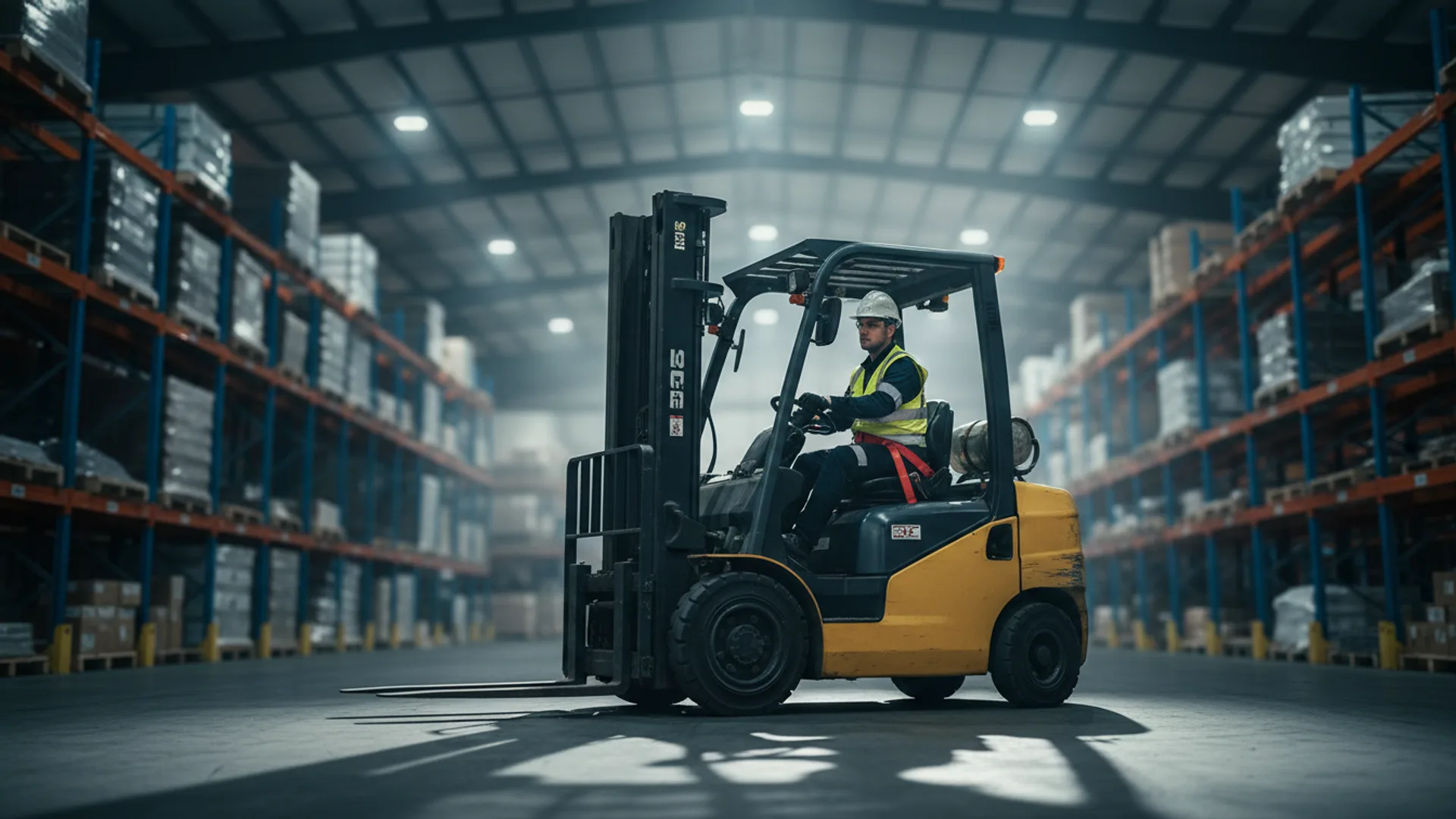
In practice, compliance comes down to three things: the right HRW class, a current valid licence, and a workplace that verifies competency before operation begins.
That applies equally in warehouses, commercial job sites, manufacturing plants, and short-term hire situations. The same legal requirement follows the person operating the forklift wherever the work happens.
Understanding Forklift Licence Classes in Australia
In Australia, forklift operators must hold one of two nationally recognised HRW licence classes, depending on the type of forklift they operate.
The national HRW licence system ensures consistency across all states and territories. Queensland adopted the model WHS laws developed by Safe Work Australia, meaning the licence classes, training standards, and regulatory framework align with the rest of the country.
LF (Forklift Truck)
Covers the operation of counterbalance forklifts and reach forklifts, the most common types used in warehousing and logistics. If you work with a standard pallet-handling forklift, this is the licence class you need.
LO (Order Picking Forklift)
Covers forklifts where the operator is elevated along with the forks and load, such as those used in high-bay warehouses for order picking at height. This is a separate class from LF and requires its own training and assessment.
A key advantage of the HRW licence system is national portability. A licence issued by WHSQ in Queensland is recognised in New South Wales, Victoria, Western Australia, and all other Australian states and territories. If you move interstate or take on work in another state, your Queensland HRW licence remains valid.
How to Get a Forklift Licence in Queensland: Step by Step
Getting a forklift licence in Queensland involves two distinct stages: completing accredited training with an RTO, and then applying for the HRW licence through WHSQ. Many people confuse the training certificate with the licence itself, they are separate documents issued by different bodies.
Here is the complete process:
Meet the eligibility requirements.You must be at least 18 years of age and hold valid, acceptable proof of identity (such as a current driver’s licence or passport).
Enrol in an accredited training course. Training must be completed through a Registered Training Organisation (RTO) accredited by the Australian Skills Quality Authority (ASQA). The relevant nationally accredited unit of competency is TLILIC0003, Licence to Operate a Forklift Truck. Courses typically run between one and three days, covering both theory and practical operation.
Complete theoretical and practical assessments. Your RTO will assess your knowledge of forklift safety, load handling principles, pre-operational checks, and relevant legislation, as well as your practical ability to operate the equipment safely.
Receive your Statement of Attainment. Upon successfully completing training and assessment, your RTO issues a Statement of Attainment for TLILIC0003. This is your training certificate, it is not your HRW licence.
Apply for your HRW licence through WHSQ. Submit your HRW licence application through the Queensland Government’s online portal at worksafe.qld.gov.au. You will need to provide your Statement of Attainment, proof of identity, and pay the applicable government fee. Check the current WHSQ fee schedule directly on their website, as fees are updated periodically.
Receive your HRW licence card. Once approved, WHSQ issues your HRW licence card, which is valid for five years from the date of issue.
Renew before expiry. You must renew your HRW licence before it expires. WHSQ will typically send a renewal reminder. Operating on an expired licence carries the same legal consequences as operating without one.
Do You Need a Licence to Operate a Hired Forklift in Queensland?
Yes, the requirement for a valid HRW licence applies regardless of whether the forklift is owned, leased, or hired from an equipment hire company.
This is one of the most commonly misunderstood aspects of Queensland forklift regulation. Some operators or business owners assume that hiring a forklift from a third-party company places licensing responsibility on the hire company, or that the hire agreement satisfies some form of operating authority. This is incorrect.
Under the Work Health and Safety Regulation 2011 (Qld), the HRW licence requirement is attached to the operator, not the machine or its ownership. Whether you are operating your employer’s forklift, a machine hired by your business, or a short-term hire unit brought in for a specific project, you must hold a current LF or LO class HRW licence to operate it lawfully.
Additionally, employers who allow unlicensed operators to use a hired forklift are in breach of their PCBU duties under the Work Health and Safety Act 2011 (Qld), exposing themselves to enforcement action, improvement notices, and substantial penalties.
Forklift hire companies may also ask to sight the operator’s licence before releasing equipment as part of their own duty of care obligations. If you cannot produce a valid HRW licence, a reputable hire company should decline to release the machine.
Queensland and Australian Regulations for Forklift Operation
Forklift operation in Queensland is governed by a layered framework of legislation, regulations, and codes of practice that together define the obligations of operators, employers, and equipment owners.
Key Legislative and Regulatory References
The primary legislation establishing the duty of care obligations of PCBUs and workers. It requires that all persons at a workplace take reasonable steps to ensure health and safety, so far as is reasonably practicable.
Specifically addresses plant and structures, including licensing requirements for high risk plant such as forklifts.
Queensland adopted the model WHS framework, ensuring alignment with national standards for plant licensing, risk management, and incident reporting.
Provides practical guidance on pre-operational checks, maintenance requirements, and traffic management for mobile plant.
Sets technical standards for forklift design, performance, and safe use in Australian workplaces.
Employer (PCBU) Obligations
Under Queensland WHS law, employers must:
- Verify that all operators hold a current, valid HRW licence before authorising forklift operation
- Implement a traffic management plan that separates pedestrians from forklift operating areas
- Ensure all forklifts are regularly inspected and maintained in accordance with manufacturer specifications
- Provide adequate supervision for operators, particularly those new to the role or workplace
- Report notifiable incidents (including serious injuries, deaths, and dangerous near-misses) to WHSQ immediately
- Maintain records of pre-operational inspections and maintenance activities
Operator Obligations
Operators are legally required to:
- Hold a valid HRW licence for the class of forklift being operated
- Complete pre-operational checks before each shift and record findings
- Operate the forklift in accordance with its rated load capacity and safe operating procedures
- Report hazards, defects, and incidents to their supervisor promptly
- Not operate a forklift while affected by alcohol, drugs, fatigue, or any condition that impairs their capacity
Penalties for Non-Compliance
Essential Pre-Operational Safety Checks for Forklifts
A pre-operational inspection must be completed before every shift, not just at the start of the week or when a new operator takes over. According to Safe Work Australia’s Code of Practice: Managing Risks of Plant in the Workplace, operators are responsible for checking that their forklift is in safe working condition before use. Skipping this check is both a safety risk and a regulatory breach.
If a defect is found during the pre-op check, the forklift must be taken out of service immediately, tagged out with a defect label, and the issue reported to a supervisor before operation resumes. Never operate a forklift with a known fault.
External Checks (Before Starting the Engine)
- Tyres: Check condition, inflation pressure (pneumatic tyres), and look for cuts, embedded objects, or damage
- Forks: Inspect for cracks, bends, or excessive wear at the heel. Confirm locking pins are secured and both forks are level
- Mast and chains: Check for damage, chain stretch, or lubrication deficiency; inspect for cracks or distortion in the mast
- Hydraulic hoses and cylinders: Look for leaks, abrasion, or damage along all visible hose runs
- Fluid levels: Check engine oil, coolant, hydraulic fluid, and fuel (or battery charge level for electric forklifts)
- LPG hose and cylinder: If LPG-powered, inspect the hose for damage and confirm the cylinder is securely mounted
- Lights and horn: Test headlights, rear lights, and the horn to confirm they are operational
- Warning devices: Confirm the reverse alarm (beeper) and any flashing lights are functioning
- Overhead guard: Check for structural integrity and confirm it is securely attached
- Counterweight: Confirm it is intact and securely bolted
- Seatbelt: Check the seatbelt for fraying, proper retraction, and that the buckle latches and releases correctly
Operational Checks (During Start-Up)
- Service brakes: Test that the foot brake brings the forklift to a smooth, controlled stop
- Parking brake: Engage the parking brake and confirm it holds the forklift stationary
- Steering: Check for smooth, responsive steering with no excessive play
- Lifting mechanism: Raise, lower, and tilt the forks to confirm smooth, consistent hydraulic operation with no jerking or unusual noise
- Dashboard warning lights: Confirm no fault warnings are displayed after start-up
- Hour meter: Record the hour meter reading for maintenance scheduling purposes
Post-Check Procedure
Common Causes of Forklift Accidents in Warehouses
According to Safe Work Australia, forklifts are involved in a disproportionately high number of serious workplace injuries and fatalities in Australia’s transport, storage, and logistics sectors. Understanding the most common incident types is the first step in preventing them.
Pedestrian and forklift collisions
The leading cause of serious forklift-related injuries. Pedestrians in or near forklift operating areas face the highest risk.
Forklift tip-overs
The leading cause of forklift-related fatalities. Tip-overs occur when operators exceed the rated load capacity, corner at excessive speed, or travel on uneven or sloped surfaces with an elevated load.
Falling loads
Unsecured, unbalanced, or overloaded pallets can shift or fall during travel or lifting, striking workers below or nearby.
Operator crush injuries
Often occur when operators attempt to jump clear during a tip-over rather than staying in the cab, or when entering and exiting incorrectly.
Reversing incidents
Forklifts have limited rear visibility, making pedestrians and objects difficult to see when reversing.
Ramp and loading dock accidents
Operating on ramps, dock levellers, or inclines with an inappropriate load angle or excessive speed causes tip-overs and load falls.
Overhead structure contact
Masts elevated in confined spaces or low-clearance areas strike overhead pipes, racking, sprinkler systems, or building structures.
Unlicensed or undertrained operation
Post-incident investigations by WHSQ consistently identify unlicensed operation or inadequate training as contributing factors in serious forklift incidents.
Safe Operating Practices for Forklift Operators in Queensland
Beyond the legal minimum of holding a valid HRW licence, safe forklift operation requires consistent on-the-job behaviours that reduce risk for the operator, other workers, and the public.
Adhere to site-specific speed limits, typically 10 km/h or less indoors and in high-pedestrian areas. Slow down further at intersections, doorways, and blind corners. Always sound the horn before entering a blind aisle or crossing a pedestrian walkway.
Never exceed the forklift’s rated load capacity as shown on the data plate attached to the mast. The data plate specifies maximum load weight at a given load centre, these figures must not be treated as guidelines. During travel, carry loads with forks 150–300mm from the ground to maintain stability and forward visibility.
Respect all designated pedestrian walkways and forklift exclusion zones. Do not allow passengers to ride on the forklift unless a purpose-built operator position is provided. Never allow anyone to stand or walk under an elevated load.
Operators must not work while fatigued, unwell, or affected by alcohol or drugs. Under the Work Health and Safety Act 2011 (Qld)
| Licence Class | Forklift Type Covered | Issuing Authority in QLD |
|---|---|---|
| LF | Counterbalance forklifts and reach forklifts | Workplace Health and Safety Queensland (WHSQ) |
| LO | Order picking forklifts (operator elevated with load) | Workplace Health and Safety Queensland (WHSQ) |
Need a Forklift for Your Queensland Site?
Talk to our team about the right forklift for your job, site conditions and operating requirements.